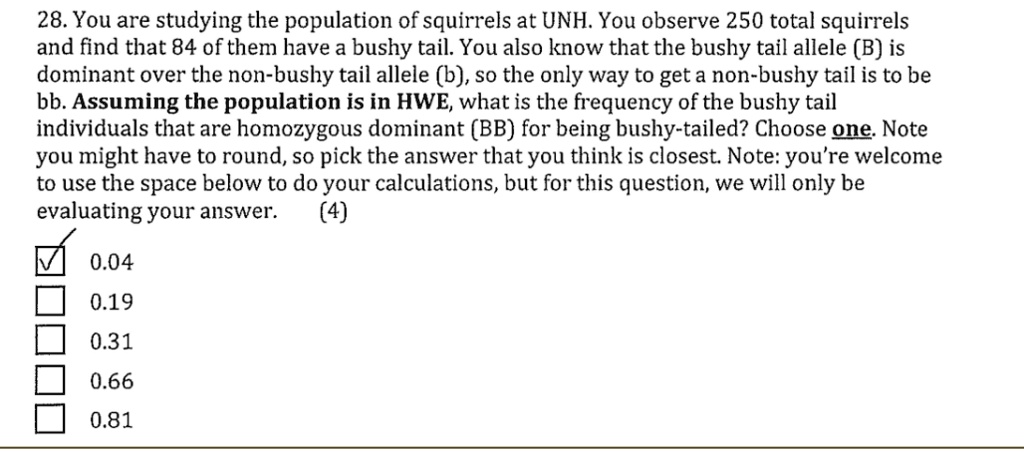
28. You are studying the population of squirrels at UNH. You observe 250 total squirrels and find that 84 of them have a bushy tail. You also know that the bushy tail allele (B) is dominant over the non-bushy tail allele (b), so the only way to get a non-bushy tail is to be bb. Assuming the population is in HWE, what is the frequency of the bushy tail individuals that are homozygous dominant (BB) for being bushy-tailed? Choose one. Note you might have to round, so pick the answer that you think is closest. Note: you're welcome to use the space below to do your calculations, but for this question, we will only be evaluating your answer.
(4)
0.04
0.19
0.31
0.66
0.81