3. A decision at the margin
Gilberto is a hard-working college freshman. One Tuesday, he decides to work nonstop until he has answered 250 practice problems for his physics
course. He starts work at 8:00 AM and uses a table to keep track of his progress throughout the day. He notices that as he gets tired, it takes him longer
to solve each problem.
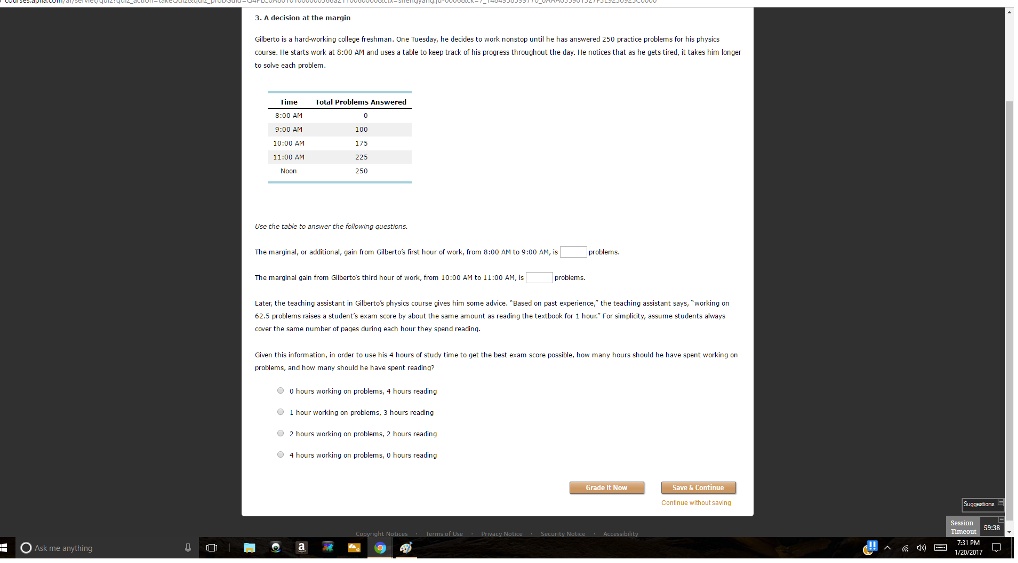
Time Total Problems Answered
8:00 AM 0
9:00 AM 100
10:00 AM 175
11:00 AM 225
Noon 250
Use the table to answer the following questions.
The marginal, or additional, gain from Gilberto's first hour of work, from 8:00 AM to 9:00 AM, is ____ problems.
The marginal gain from Gilberto's third hour of work, from 10:00 AM to 11:00 AM, is ____ problems.
Later, the teaching assistant in Gilberto's physics course gives him some advice. "Based on past experience," the teaching assistant says, "working on
62.5 problems raises a student's exam score by about the same amount as reading the textbook for 1 hour." For simplicity, assume students always
cover the same number of pages during each hour they spend reading.
Given this information, in order to use his 4 hours of study time to get the best exam score possible, how many hours should he have spent working on
problems, and how many should he have spent reading?
? 0 hours working on problems, 4 hours reading
? 1 hour working on problems, 3 hours reading
? 2 hours working on problems, 2 hours reading
? 4 hours working on problems, 0 hours reading