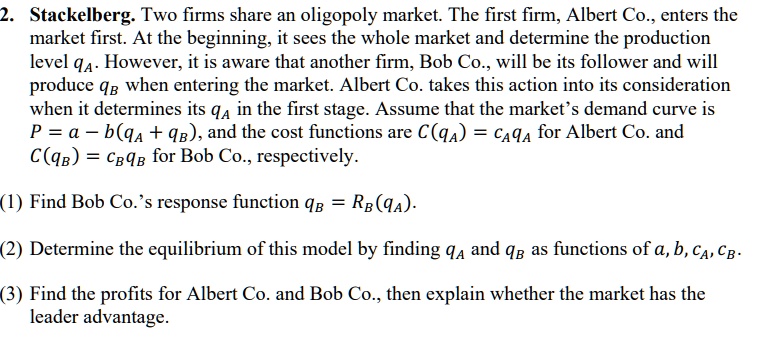
2. Stackelberg. Two firms share an oligopoly market. The first firm, Albert Co., enters the market first. At the beginning, it sees the whole market and determine the production level $q_A$. However, it is aware that another firm, Bob Co., will be its follower and will produce $q_B$ when entering the market. Albert Co. takes this action into its consideration when it determines its $q_A$ in the first stage. Assume that the market's demand curve is $P = a - b(q_A + q_B)$, and the cost functions are $C(q_A) = c_Aq_A$ for Albert Co. and $C(q_B) = c_Bq_B$ for Bob Co., respectively.
(1) Find Bob Co.'s response function $q_B = R_B(q_A)$.
(2) Determine the equilibrium of this model by finding $q_A$ and $q_B$ as functions of $a$, $b$, $c_A$, $c_B$.
(3) Find the profits for Albert Co. and Bob Co., then explain whether the market has the leader advantage.