Ace - AI Tutor
Ask Our Educators
Textbooks
My Library
Flashcards
Scribe - AI Notes
Notes & Exams
Download App
joshua bailey

joshua b.

Divider

Questions asked

BEST MATCH

Is it possible for a normal force to be different in magnitude than an objects weight?

View Answer
divider
BEST MATCH

Economically, self sufficiency can lead to inefficiency and inefficiency leads to poverty. Question 2 options: True False

View Answer
divider
BEST MATCH

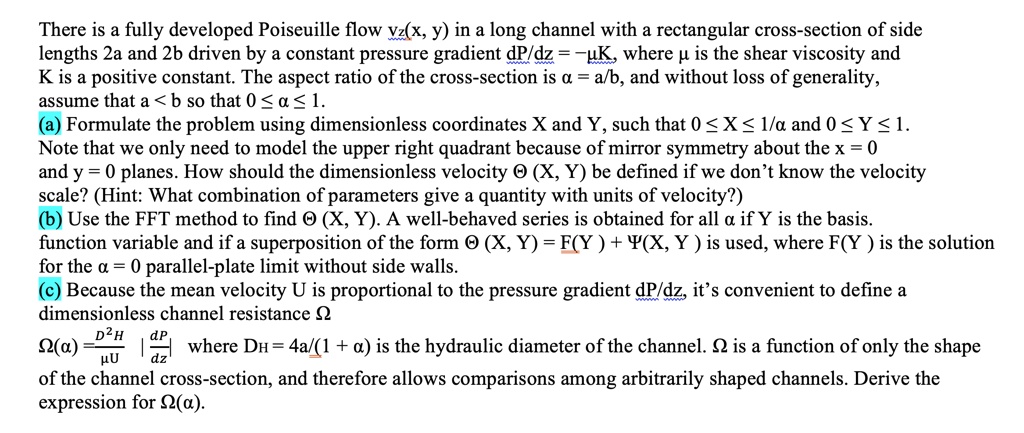
There is a fully developed Poiseuille flow $v_z(x, y)$ in a long channel with a rectangular cross-section of side lengths 2a and 2b driven by a constant pressure gradient $\frac{dP}{dz} = -\mu K$, where $\mu$ is the shear viscosity and K is a positive constant. The aspect ratio of the cross-section is $a = a/b$, and without loss of generality, assume that $a < b$ so that $0 \le a \le 1$. (a) Formulate the problem using dimensionless coordinates X and Y, such that $0 \le X \le 1/a$ and $0 \le Y \le 1$. Note that we only need to model the upper right quadrant because of mirror symmetry about the x = 0 and y = 0 planes. How should the dimensionless velocity $\Theta(X, Y)$ be defined if we don't know the velocity scale? (Hint: What combination of parameters give a quantity with units of velocity?) (b) Use the FFT method to find $\Theta(X, Y)$. A well-behaved series is obtained for all a if Y is the basis function variable and if a superposition of the form $\Theta(X, Y) = F(Y) + \Psi(X, Y)$ is used, where F(Y) is the solution for the $a = 0$ parallel-plate limit without side walls. (c) Because the mean velocity U is proportional to the pressure gradient $\frac{dP}{dz}$, it's convenient to define a dimensionless channel resistance $\Omega$ $\Omega(a) = \frac{D_H^2}{\mu U} |\frac{dP}{dz}|$ where $D_H = \frac{4a}{(1 + a)}$ is the hydraulic diameter of the channel. $\Omega$ is a function of only the shape of the channel cross-section, and therefore allows comparisons among arbitrarily shaped channels. Derive the expression for $\Omega(a)$.
View Answer
divider
BEST MATCH

Find I in the figure below. 20 13 58 10 20v

View Answer
divider
BEST MATCH

Q2: Find Elmore's delay $T_{D_i}$, where i varies from 1 to 8. Assume all resistances to be of 1 kOhms and capacitances of 10 fF.

View Answer
divider
BEST MATCH

Part A The velocity of water changes uniformly along the transition from $V_A$ = 10 m/s to $V_B$ = 4 m/s. $\rho_w$ = 1000 kg/m$^3$. Assume the fluid is an ideal fluid, that is, incompressible and frictionless. (Figure 1) Determine the pressure difference between A and x = 1.5 m. Express your answer using three significant figures. p(x) - $p_A$ = Value Units Submit Request Answer Provide Feedback

View Answer
divider
BEST MATCH

4. Calculate the current through the diode D1 and Vout shown in Figure 2. Assume V1=12V, R1=2K? and D1 as Silicon diode. [1 mark] Vout V1 Figure 2 R1

View Answer
divider
BEST MATCH

3.- Determinar los valores de A, B, C, D y E de tal manera que se cumpla la igualdad: \frac{3x^4 + 4x^3 + 16x^2 + 20x + 9}{(x + 2)(x^2 + 3)^2} = \frac{A}{x + 2} + \frac{Bx + C}{x^2 + 3} + \frac{Dx + E}{(x^2 + 3)^2}

View Answer
divider
BEST MATCH

1) Enlarge shape A by a scale factor of 2. Label the new shape A' Enlarge shape B by a scale factor of \frac{1}{3} Label the new shape B'

View Answer
divider
BEST MATCH

A veterinarian treated the following animals. 50 dogs, 35 cats, 14 birds, and 4 hamsters. a. Find the probability that the next animal treated is a dog. b. Find the probability that the next animal treated is a cat. c. Find the probability that the next animals treated is NOT a cat.

View Answer
divider