Ace - AI Tutor
Ask Our Educators
Textbooks
My Library
Flashcards
Scribe - AI Notes
Notes & Exams
Download App
joshua barron

joshua b.

Divider

Questions asked

BEST MATCH

Question 3 Which of the following is the best way to synthesize 1-bromobutane? CH_(3)CH_(2)CH_(2)CH_(2)OH Br_(2) q, CH_(3)CH_(2)CH_(2)CH_(2)OH PBr_(3) q, CH_(3)CH_(2)CH=CH_(2) HBr q, None of these choices. CH_(3)CH_(2)CHOHCH_(3) HBr q,

View Answer
divider
BEST MATCH

Is fertilization in a perch internal or external, and is perch reproduction dependent upon water?

View Answer
divider
BEST MATCH

Which of the following is most commonly associated with Valley Fever? Question 2 options: Aspergillus Cryptococcosis Coccidioidmycosis Histoplasmosis

View Answer
divider
BEST MATCH

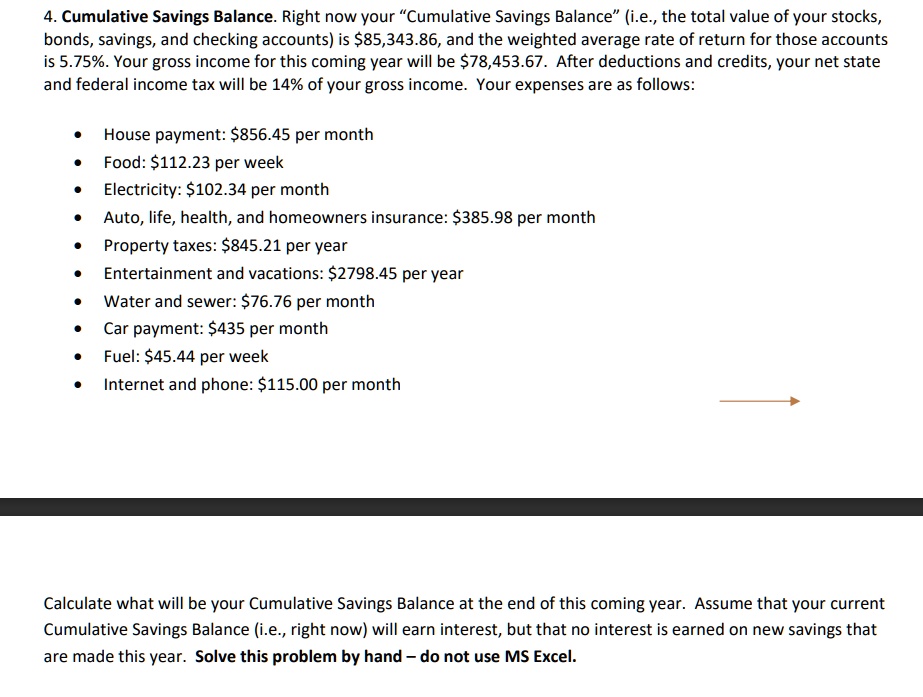
4. Cumulative Savings Balance. Right now your "Cumulative Savings Balance" (i.e., the total value of your stocks, bonds, savings, and checking accounts) is $85,343.86, and the weighted average rate of return for those accounts is 5.75%. Your gross income for this coming year will be $78,453.67. After deductions and credits, your net state and federal income tax will be 14% of your gross income. Your expenses are as follows: \begin{itemize} \item House payment: $856.45 per month \item Food: $112.23 per week \item Electricity: $102.34 per month \item Auto, life, health, and homeowners insurance: $385.98 per month \item Property taxes: $845.21 per year \item Entertainment and vacations: $2798.45 per year \item Water and sewer: $76.76 per month \item Car payment: $435 per month \item Fuel: $45.44 per week \item Internet and phone: $115.00 per month \end{itemize} Calculate what will be your Cumulative Savings Balance at the end of this coming year. Assume that your current Cumulative Savings Balance (i.e., right now) will earn interest, but that no interest is earned on new savings that are made this year. Solve this problem by hand - do not use MS Excel.
View Answer
divider
BEST MATCH

The human cerebral cortex is characterized by grooves and bulges. The grooves are known as ________ and the bulges are known as ________. sulci; fissures sulci; gyri fissures; sulci gyri; sulci

View Answer
divider
BEST MATCH

Which field of genetics uses a genetic cross to determine patterns of inheritance? Select one: Population genetics Transmission genetics Molecular genetics Cytogenetics

View Answer
divider
BEST MATCH

Question 1 (2 points) Where are erythrocytes produced? Heart Red Bone Marrow Kidneys Yellow Bone Marrow

View Answer
divider
BEST MATCH

Solve for $x$\\ $\frac{1}{x - 2} = \frac{5}{x - 3}$ \\ $x = $

View Answer
divider
BEST MATCH

1. Describe how intermolecular forces might be responsible for the observed order of melting points for Naphthalene, Iodine, Sucrose, and NaCl. 2. Describe how intermolecular forces might be responsible for the observed order of evaporation rates for ethanol, methanol, and acetone. 3. How do you think water and glycerol’s rate of evaporation would compare to the rates for ethanol, methanol, and acetone? Faster or slower? Explain your answer using intermolecular forces. 4. In which solvent (hexane/water) did iodine and NaCl dissolve? Describe how intermolecular forces might be responsible for the observed solubility or insolubility of iodine and NaCl in hexane and water. Be specific in your response; include which intermolecular forces are involved.

View Answer
divider
BEST MATCH

This is a differential equations question. It is dropped from a height of 300m. The falling object in Example 2 satisfies the initial value problem dv/dt = 9.8 - (v/5), v(0) = 0. (a) Find the time that must elapse for the object to reach 98% of its limiting velocity. (b) How far does the object fall in the time found in part (a)? Modify example 2 so that the falling object experiences no air resistance. (a) Write down the modified initial value problem. (b) Determine how long it takes the object to reach the ground. (c) Determine its velocity at the time of impact.

View Answer
divider