TIGHT BINDING MODEL
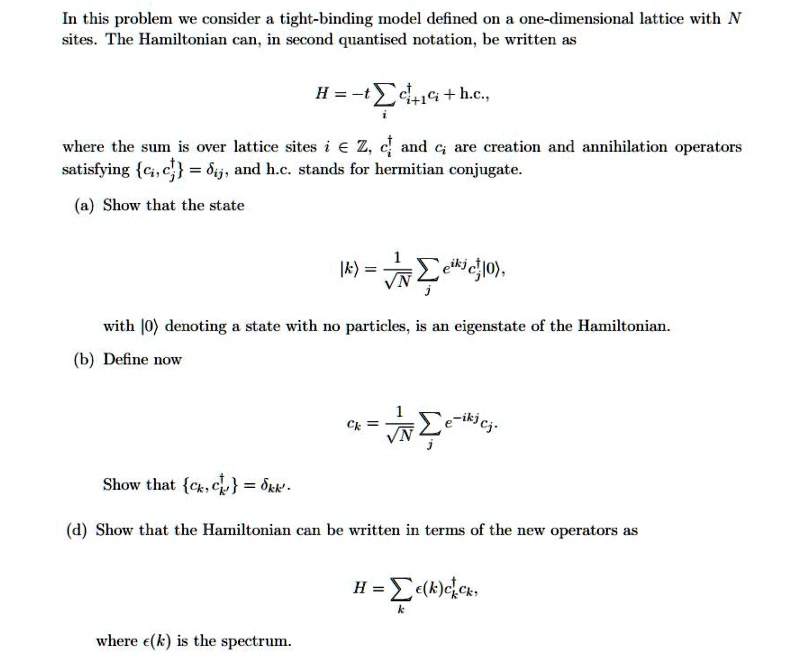
In this problem we consider a tight-binding model defined on a one-dimensional lattice with N
sites. The Hamiltonian can, in second quantised notation, be written as
H=-tsum_i c_(i+1)^(†)c_(i)+ h.c.,
where the sum is over lattice sites iinZ,c_(i)^(†) and c_(i) are creation and annihilation operators
satisfying {c_(i),c_(j)^(†)}=delta _(ij), and h.c. stands for hermitian conjugate.
(a) Show that the state
|k:
with |0: denoting a state with no particles, is an eigenstate of the Hamiltonian.
(b) Define now
c_(k)=(1)/(sqrt(N))sum_j e^(-ikj)c_(j).
Show that {c_(k),c_(k^('))^(†)}=delta _(kk^(')).
(d) Show that the Hamiltonian can be written in terms of the new operators as
H=sum_k epsi lon(k)c_(k)^(†)c_(k),
where epsi lon(k) is the spectrum.
In this problem we consider a tight-binding model defined on a one-dimensional lattice with N sites. The Hamiltonian can,in second quantised notation,be written as
H=-tc+1ci+h.c.
where the sum is over lattice sites i e Z, c and c are creation and annihilation operators satisfying{ci,c}=ij, and h.c. stands for hermitian conjugate.
(a) Show that the state
|k= VN
with |0 denoting a state with no particles, is an eigenstate of the Hamiltonian
(b)Define now
VN
Show that{ckcf}=k
(d Show that the Hamiltonian can be written in terms of the new operators as
H=> kcc
where e(kis the spectrum