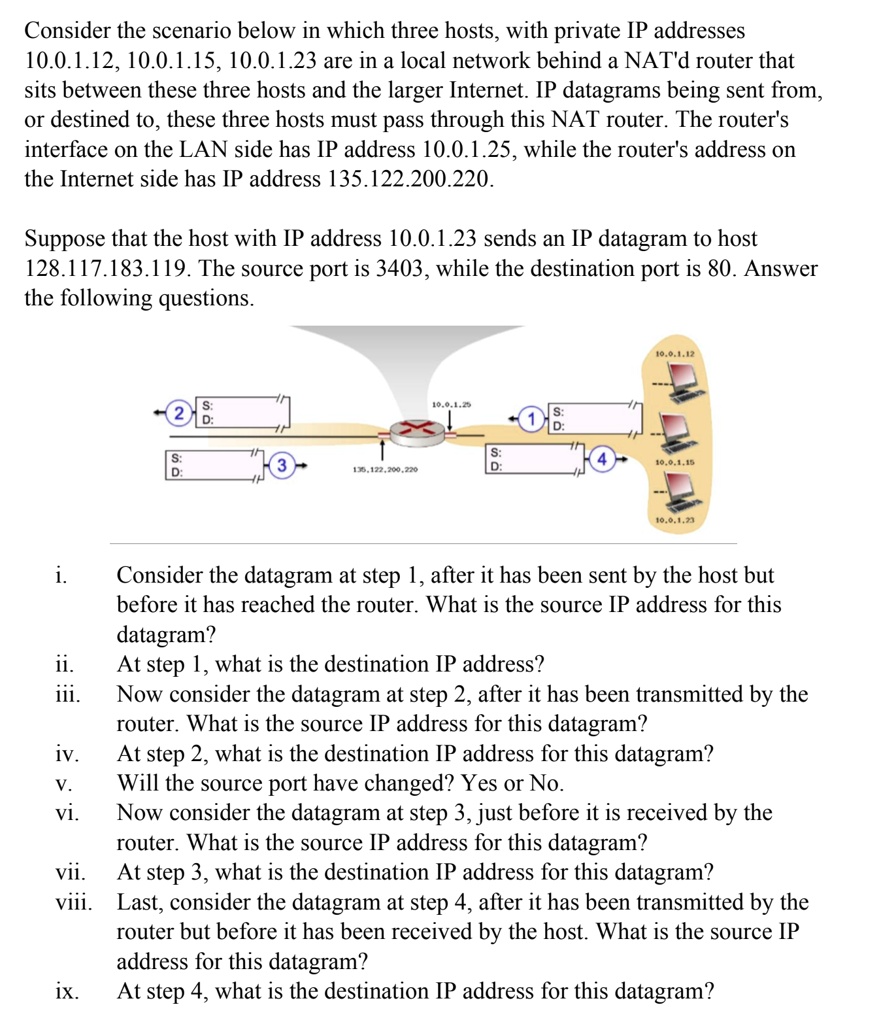
Consider the scenario below in which three hosts, with private IP addresses
10.0.1.12, 10.0.1.15, 10.0.1.23 are in a local network behind a NAT'd router that
sits between these three hosts and the larger Internet. IP datagrams being sent from,
or destined to, these three hosts must pass through this NAT router. The router's
interface on the LAN side has IP address 10.0.1.25, while the router's address on
the Internet side has IP address 135.122.200.220.
Suppose that the host with IP address 10.0.1.23 sends an IP datagram to host
128.117.183.119. The source port is 3403, while the destination port is 80. Answer
the following questions.
i. Consider the datagram at step 1, after it has been sent by the host but
before it has reached the router. What is the source IP address for this
datagram?
ii. At step 1, what is the destination IP address?
iii. Now consider the datagram at step 2, after it has been transmitted by the
router. What is the source IP address for this datagram?
iv. At step 2, what is the destination IP address for this datagram?
V. Will the source port have changed? Yes or No.
vi. Now consider the datagram at step 3, just before it is received by the
router. What is the source IP address for this datagram?
vii. At step 3, what is the destination IP address for this datagram?
viii. Last, consider the datagram at step 4, after it has been transmitted by the
router but before it has been received by the host. What is the source IP
address for this datagram?
ix. At step 4, what is the destination IP address for this datagram?