2. Carrier-Injection Electroluminescence Spectral Intensity (10 + 10 Points).
When carriers are pumped into an LED, the luminescence can be calculated using the
expression:
\frac{1}{\tau_r(\nu)} = \frac{1}{\tau_r} g(\nu) f(\nu)
where the function $g(\nu)$ is the optical joint density of states and is given by
$g(\nu) = \frac{(2m_r)^{3/2}}{\pi^2 \hbar^3} \sqrt{h\nu - E_c}$
And the emission-condition probability is given by
$f(\nu) = f_c[E_c(\nu)] - f_v[E_v(\nu)] = exp\left[-\left(\frac{h\nu - \Delta E_F}{k_B T}\right)\right]$
Estimate the difference in quasi-Fermi levels $\Delta E_F$ using the equation
$\Delta E_F = E_c + (3\pi^2) \frac{\hbar^2}{2m_e} (\Delta n)^{2/3}$
Estimate the injected carrier concentration $\Delta n$ using the equation
$\Delta n = \frac{(I/e)}{V}\tau$
where $I$ is DC electrical current flowing through the LED, $e$ is the fundamental charge
(approximately $1.602 \times 10^{-19}$ C), $\tau$ is the total recombination lifetime, and $V$ is the volume of
the region in which electron-hole recombination takes place.
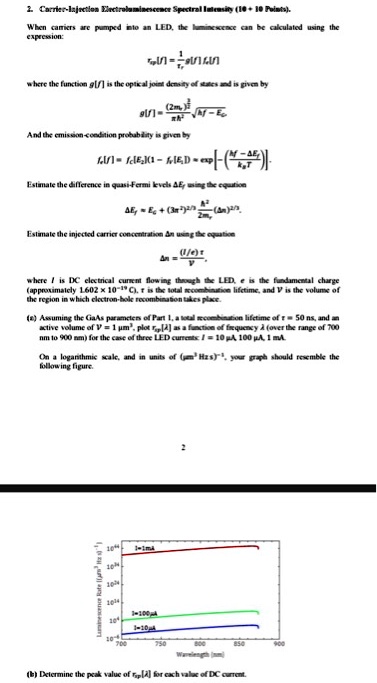
(a) Assuming the GaAs parameters of Part 1, a total recombination lifetime of $\tau = 50$ ns, and an
active volume of $V = 1 \,\mu m^2$, plot $\tau_r(\lambda)$ as a function of frequency $\lambda$ (over the range of 700
nm to 900 nm) for the case of three LED currents: $I = 10 \,\mu A$, $100 \,\mu A$, $1 \,\text{mA}$.
On a logarithmic scale, and in units of $(\mu m^3 \text{Hz s}^{-1})$, your graph should resemble the
following figure.
2
(b) Determine the peak value of $\tau_r(\lambda)$ for each value of DC current.