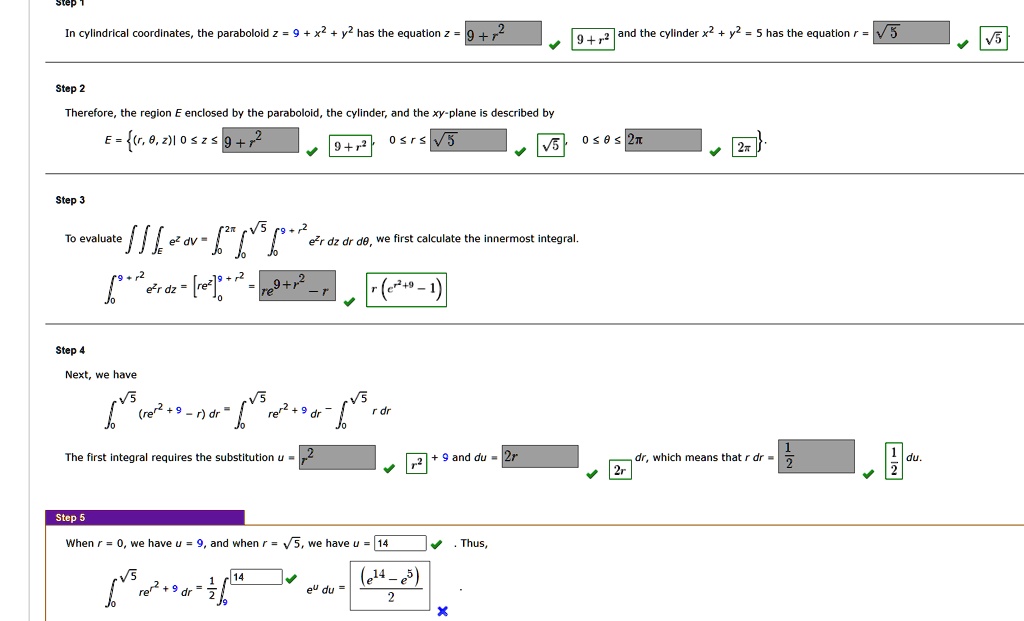
In cylindrical coordinates, the paraboloid $z = 9 + x^2 + y^2$ has the equation $z = 9 + r^2$ and the cylinder $x^2 + y^2 = 5$ has the equation $r = \sqrt{5}$
Step 2
Therefore, the region E enclosed by the paraboloid, the cylinder, and the xy-plane is described by
$E = \{(r, \theta, z) | 0 \le z \le 9 + r^2, 0 \le r \le \sqrt{5}, 0 \le \theta \le 2\pi\}$
Step 3
To evaluate $\iiint_E e^z dV = \int_0^{2\pi} \int_0^{\sqrt{5}} \int_0^{9+r^2} e^z r dz dr d\theta$, we first calculate the innermost integral.
$\int_0^{9+r^2} e^z r dz = [re^z]_0^{9+r^2} = re^{9+r^2} - r$
Step 4
Next, we have
$\int_0^{\sqrt{5}} (re^{9+r^2} - r) dr = \int_0^{\sqrt{5}} re^{9+r^2} dr - \int_0^{\sqrt{5}} r dr$
The first integral requires the substitution $u = r^2 + 9$ and $du = 2r dr$, which means that $r dr = \frac{1}{2} du$.
Step 5
When $r = 0$, we have $u = 9$, and when $r = \sqrt{5}$, we have $u = 14$. Thus,
$\int_0^{\sqrt{5}} re^{9+r^2} dr = \frac{1}{2} \int_9^{14} e^u du = \frac{1}{2} (e^{14} - e^9)$