Texts: Question (25 mars)
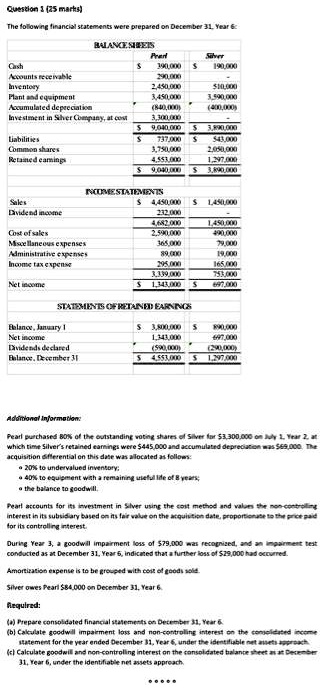
The following financial statements were prepared on December 31, Year 6:
BALANCE SHEET
Assets
Current Assets
Cash 390,000
Accounts receivable 290,000
Inventory 2,450,000
Plant and equipment 3,450,000
Accumulated depreciation (840,000)
Investment in Other Company, at cost 3,300,000
Total Assets 9,040,000
Liabilities
Current Liabilities
Common shares 3,750,000
Retained earnings 4,553,000
Total Liabilities 7,737,000
Equity
Silver 190,000
Total Equity 190,000
Total Liabilities and Equity 9,040,000
INCOME STATEMENTS
Sales 4,450,000
Dividend income 232,000
Total Revenue 4,682,000
Expenses
Cost of sales 2,590,000
Miscellaneous expenses 365,000
Administrative expenses 89,000
Income tax expense 295,000
Total Expenses 3,339,000
Net income 1,343,000
STATEMENTS OF RETAINED EARNINGS
Balance, January 1 3,800,000
Net income 890,000
Dividends (590,000)
Balance, December 31 4,300,000
Additional information:
On December 31, Silver's retained earnings were $445,000 and accumulated depreciation was $69,000. The acquisition differential on this date was allocated as follows: 20% to undervalued inventory; 40% to equipment with a remaining useful life of 5 years; the balance to goodwill.
Pearl accounts for its investment in Silver using the cost method and values the non-controlling interest in its subsidiary based on its fair value on the acquisition date. Percentage for its controlling interest.
During Year 3, a goodwill impairment loss of $579,000 was recognized and an impairment test conducted as at December 31, Year 5, indicated that a further loss of $29,000 had occurred.
Amortization expense is to be grouped with cost of goods sold. Silver owes Pearl $84,000 on December 31, Year 6.
Required:
a) Prepare consolidated financial statements on December 31, Year 6.
b) Calculate goodwill and non-controlling interest on the consolidated balance sheet as at December 31, Year 6, under the identifiable net assets approach.