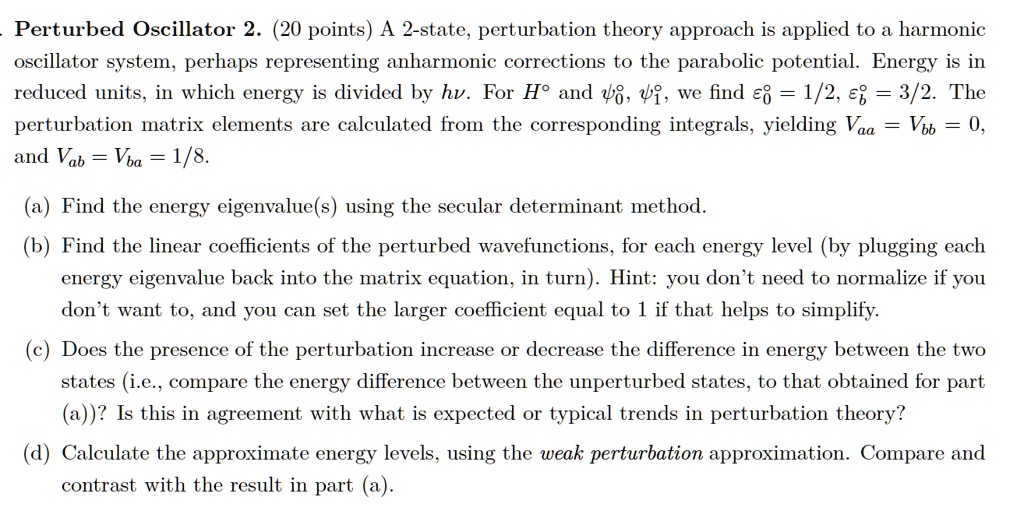
Perturbed Oscillator 2. (20 points) A 2-state perturbation theory approach is applied to a harmonic oscillator system, perhaps representing anharmonic corrections to the parabolic potential. Energy is in reduced units, in which energy is divided by hv. For H and B, we find α = 1/2 and β = 3/2. The perturbation matrix elements are calculated from the corresponding integrals, yielding Vaa = Vib = 0 and Vab = Vba = 1/8.
(a) Find the energy eigenvalue(s) using the secular determinant method.
(b) Find the linear coefficients of the perturbed wavefunctions for each energy level (by plugging each energy eigenvalue back into the matrix equation, in turn). Hint: you don't need to normalize if you don't want to, and you can set the larger coefficient equal to 1 if that helps to simplify.
(c) Does the presence of the perturbation increase or decrease the difference in energy between the two states (i.e., compare the energy difference between the unperturbed states to that obtained for part (a))? Is this in agreement with what is expected or typical trends in perturbation theory?
(d) Calculate the approximate energy levels using the weak perturbation approximation. Compare and contrast with the result in part (a).