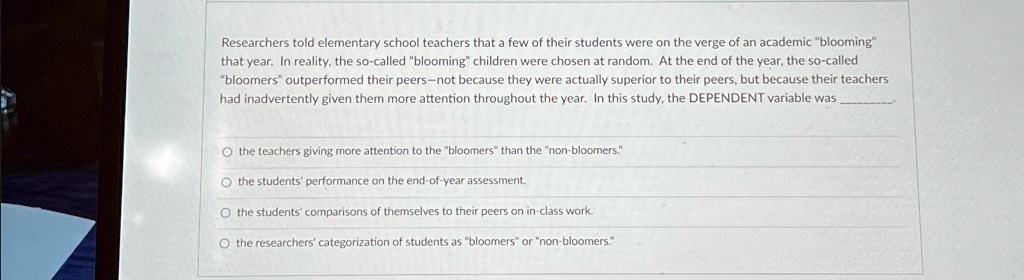
Researchers told elementary school teachers that a few of their students were on the verge of an academic "blooming" that year. In reality, the so-called "blooming" children were chosen at random. At the end of the year, the so-called "bloomers" outperformed their peers-not because they were actually superior to their peers, but because their teachers had inadvertently given them more attention throughout the year. In this study, the DEPENDENT variable was
the teachers giving more attention to the "bloomers" than the "non-bloomers."
the students' performance on the end-of-year assessment.
the students' comparisons of themselves to their peers on in-class work.
the researchers' categorization of students as "bloomers" or "non-bloomers."
Researchers told elementary school teachers that a few of their students were on the verge of an academic"blooming that year. In reality,the so-called"blooming"children were chosen at random. At the end of the year, the so-called "bloomers"outperformed their peers-not because they were actually superior to their peers,but because their teachers had inadvertently given them more attention throughout the year.In this study,the DEPENDENT variable was
O the teachers giving more attention to the "bloomers"than thenon-bloomers."
O the students'performance on the end-of-year assessment.
O the students'comparisons of themselves to their peers on in-class work.
Othe researchers'categorization of students as"bloomers"or"non-bloomers.