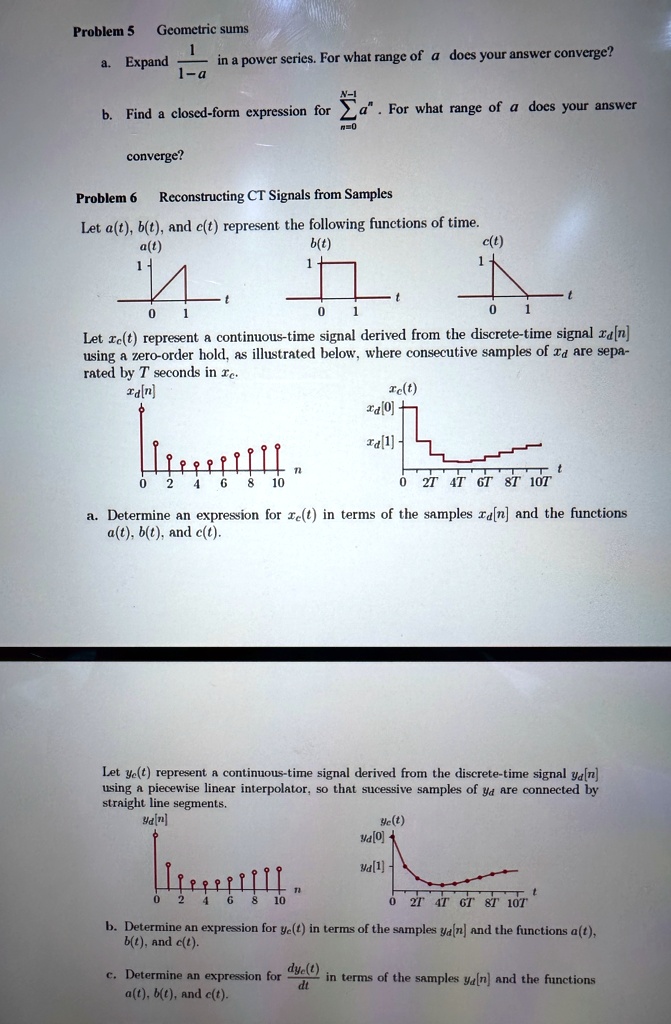
Problem 5 Geometric sums
a. Expand \frac{1}{1-a} in a power series. For what range of a does your answer converge?
b. Find a closed-form expression for \sum_{n=0}^{N-1} a^n. For what range of a does your answer converge?
Problem 6 Reconstructing CT Signals from Samples
Let a(t), b(t), and c(t) represent the following functions of time.
Let \(x_c(t)\) represent a continuous-time signal derived from the discrete-time signal \(x_d[n]\) using a zero-order hold, as illustrated below, where consecutive samples of \(x_d\) are separated by T seconds in \(x_c.
Determine an expression for \(x_c(t)\) in terms of the samples \(x_d[n]\) and the functions a(t), b(t), and c(t).
Let \(y_c(t)\) represent a continuous-time signal derived from the discrete-time signal \(y_d[n]\) using a piecewise linear interpolator, so that successive samples of \(y_d\) are connected by straight line segments.
b. Determine an expression for \(y_c(t)\) in terms of the samples \(y_d[n]\) and the functions a(t), b(t), and c(t).
c. Determine an expression for \frac{dy_c(t)}{dt} in terms of the samples \(y_d[n]\) and the functions a(t), b(t), and c(t).