Ace - AI Tutor
Ask Our Educators
Textbooks
My Library
Flashcards
Scribe - AI Notes
Notes & Exams
Download App
juan antonio stanton

juan antonio s.

Divider

Questions asked

BEST MATCH

Why is Jason's qualified business income deduction less than 20% of his qualified business income? Because:

View Answer
divider
BEST MATCH

If you had to paint a wall which option would be faster? Option1) You use one robot that can paint the entire wall in 35 minutes. Option2) You use two robots that each can paint the entire wall in 60 minutes.

View Answer
divider
BEST MATCH

Death of bone is known as ______. Group of answer choices Granuloma Carcinoma Osteonecrosis b & c

View Answer
divider
BEST MATCH

A 175 g object is attached to a spring that has a force constant of 76.5 N/m. The object is pulled 8.75 cm to the right of equilibrium and released from rest to slide on a horizontal, frictionless table. Calculate the maximum speed $v_{max}$ of the object. $v_{max}$ = 1.828 m/s Find the locations of the object when its velocity is one-third of the maximum speed. Treat the equilibrium position as zero, positions to the right as positive, and positions to the left as negative. position: -0.9 cm Incorrect position: -0.8 cm Incorrect

View Answer
divider
BEST MATCH

Find the equation of the tangent line to $f(x) = xe^x^3$ through $(1,1)$

View Answer
divider
BEST MATCH

Question 4 - Effect of temperature Homework Unanswered Due Jun 12th,11:00 AM An experiment was peformed at a low temperature and the BLUE plots shown below were obtained. The experiment was then repeated at a higher temperature(same initial concentrations). Which graph best represents how the curve at a higher temperature would differ for the blue curve? Select by clicking in the middle of the graph. Legend:The BLUE curves represent the data at a lower temperature while 1.4E-05 -10 y=-0.0105x-11.27 1.2E-05 of CV* (M) 1.0E-05 8.0E-06 6.0E-06 Concentration 4.0E-06 2.0E-06 0.0E+00 0 11 12 13 In(Concentration of CV*) 14 15 16 y = -0.0151x - 11.27 -17 0 200 Time (second) 200 400 400 Time (second) 1.4E-05 -10 10.5 -11 11.5 -12 0.0051x-11.27 In(Concentration of CV*) 12.5 -13 13.5 -14 14.5 y=-0.0105-11.27 -15 0 200 400 Time (second) 1.2E-05 M 1.0E-05 of CV* 8.0E-06 6.0E-06 Concentration 4.0E-06 2.0E-06 0.0E+00 0 200 400 Time (second) Targets placed: 2/2 Undo Delete selected Remove All

View Answer
divider
BEST MATCH

Q2. Suppose X scientist wants to compare two individuals who were kept in different conditions. How he can identify the difference at molecular level? OP

View Answer
divider
BEST MATCH

1. Describe the cache hit write policies.

View Answer
divider
BEST MATCH

5 2) Using linear approximation, calculate the approximate value of (2.01)$^5$ up to 2 decimal points.

View Answer
divider
BEST MATCH

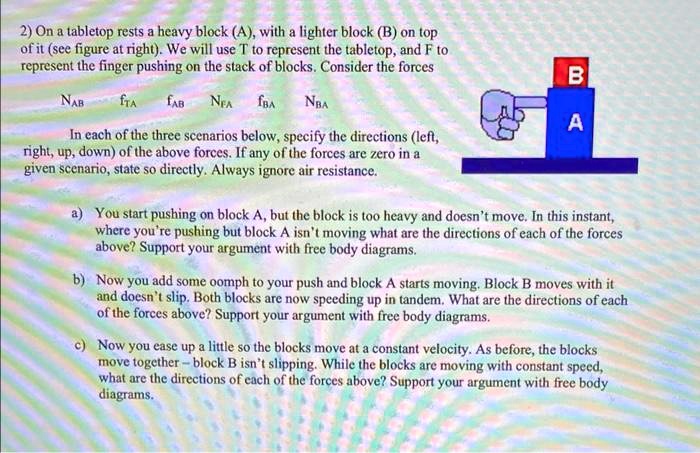
2) On a tabletop rests a heavy block (A), with a lighter block (B) on top of it (see figure at right). We will use T to represent the tabletop, and F to represent the finger pushing on the stack of blocks. Consider the forces B NAB fTA FAB NEA fBA NBA A In each of the three scenarios below, specify the directions (left, right, up, down) of the above forces. If any of the forces are zero in a given scenario, state so directly. Always ignore air resistance. a) You start pushing on block A, but the block is too heavy and doesn't move. In this instant, where you're pushing but block A isn't moving what are the directions of each of the forces above? Support your argument with free body diagrams. b) Now you add some oomph to your push and block A starts moving. Block B moves with it and doesn't slip. Both blocks are now speeding up in tandem. What are the directions of each of the forces above? Support your argument with free body diagrams. c) Now you ease up a little so the blocks move at a constant velocity. As before, the blocks move together - block B isn't slipping. While the blocks are moving with constant speed, what are the directions of each of the forces above? Support your argument with free body diagrams.
View Answer
divider