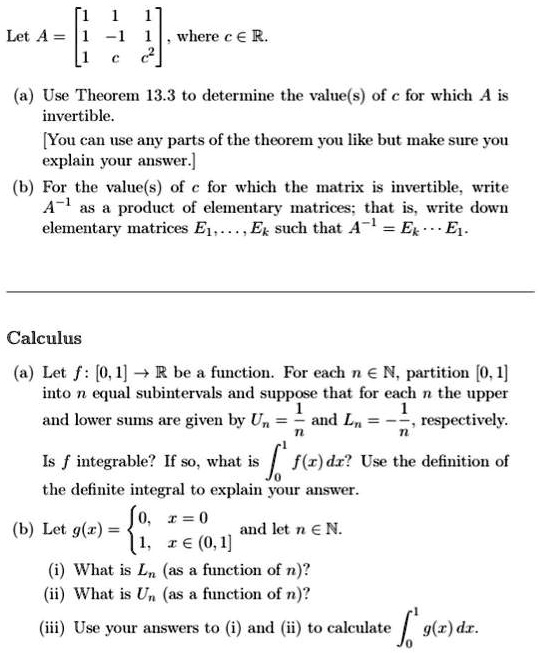
Let $A = \begin{bmatrix} 1 & 1 & 1 \ 1 & -1 & 1 \ 1 & c & c^2 \end{bmatrix}$, where $c \in \mathbb{R}$.
(a) Use Theorem 13.3 to determine the value(s) of $c$ for which $A$ is invertible.
[You can use any parts of the theorem you like but make sure you explain your answer.]
(b) For the value(s) of $c$ for which the matrix is invertible, write $A^{-1}$ as a product of elementary matrices; that is, write down elementary matrices $E_1, \dots, E_k$ such that $A^{-1} = E_k \dots E_1$.
Calculus
(a) Let $f: [0, 1] \to \mathbb{R}$ be a function. For each $n \in \mathbb{N}$, partition $[0, 1]$ into $n$ equal subintervals and suppose that for each $n$ the upper and lower sums are given by $U_n = \frac{1}{n}$ and $L_n = \frac{-1}{n}$, respectively.
Is $f$ integrable? If so, what is $\int_0^1 f(x)dx$? Use the definition of the definite integral to explain your answer.
(b) Let $g(x) = \begin{cases} 0, & x = 0 \ 1, & x \in (0, 1] \end{cases}$ and let $n \in \mathbb{N}$.
(i) What is $L_n$ (as a function of $n$)?
(ii) What is $U_n$ (as a function of $n$)?
(iii) Use your answers to (i) and (ii) to calculate $\int_0^1 g(x)dx$.