Problem 11.
R
?
The electric field vanishes inside a uniform spherical shell of charge because the shell
has exactly the right geometry to make the $1/r^2$ field produced by opposite sides of the
shell cancel according to the intuition we developed from our derivation of Gauss's Law. It
isn't a general result for arbitrary symmetries, however.
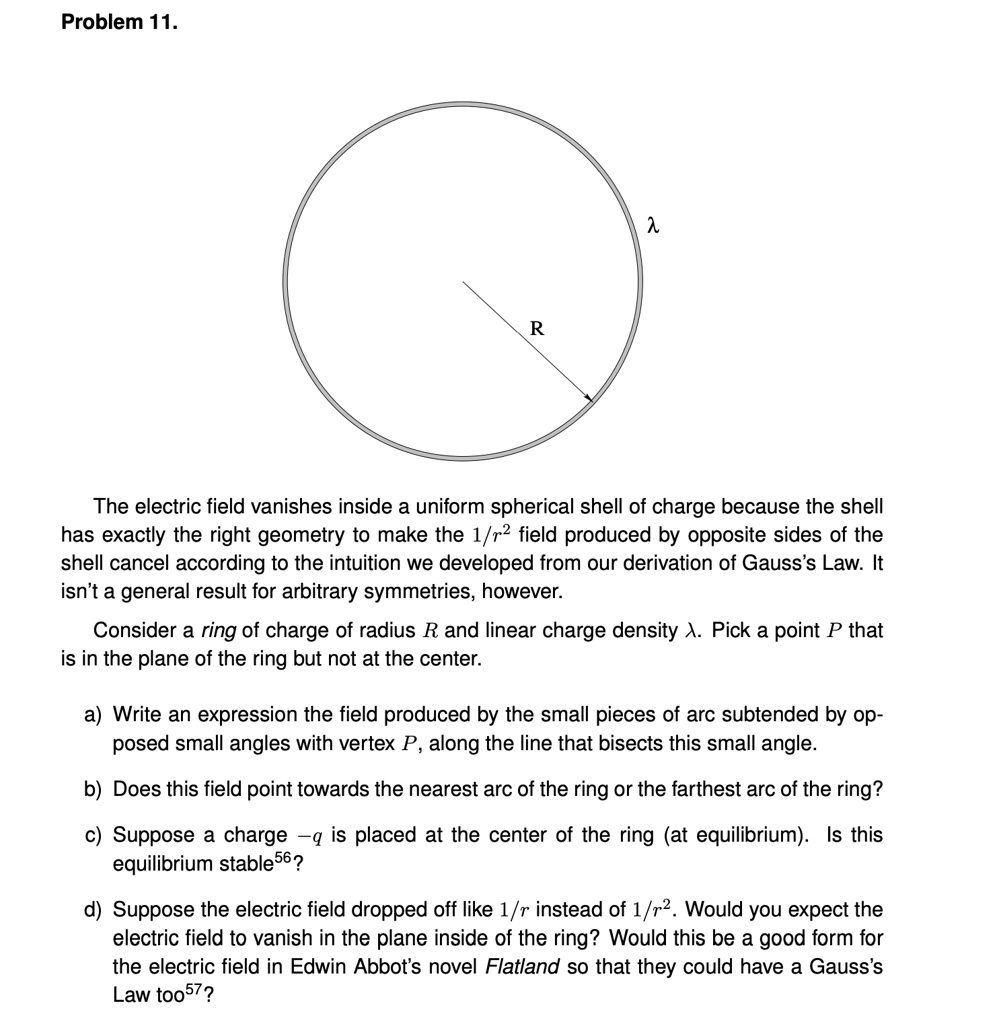
Consider a ring of charge of radius $R$ and linear charge density $\lambda$. Pick a point $P$ that
is in the plane of the ring but not at the center.
a) Write an expression the field produced by the small pieces of arc subtended by op-
posed small angles with vertex $P$, along the line that bisects this small angle.
b) Does this field point towards the nearest arc of the ring or the farthest arc of the ring?
c) Suppose a charge $-q$ is placed at the center of the ring (at equilibrium). Is this
equilibrium stable?
d) Suppose the electric field dropped off like $1/r$ instead of $1/r^2$. Would you expect the
electric field to vanish in the plane inside of the ring? Would this be a good form for
the electric field in Edwin Abbot's novel Flatland so that they could have a Gauss's
Law too?