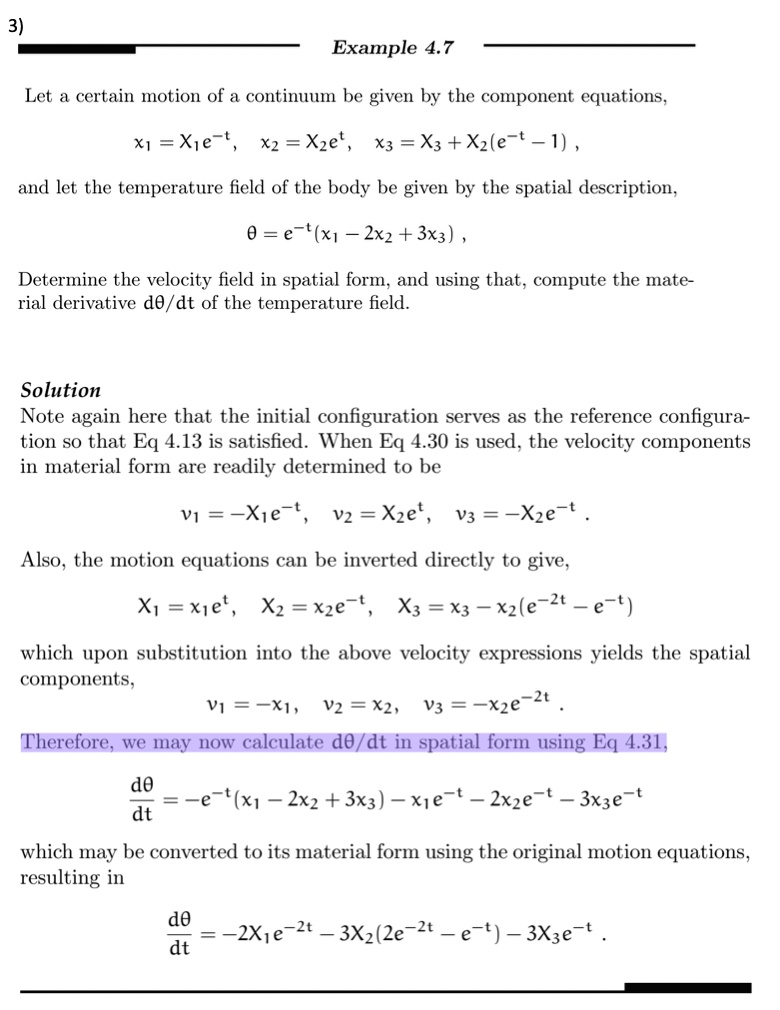
In this solution, I understood everything until the highlighted part. Can you write the steps of how to obtain that answer from the derivative of temperature, please?
Example 4.7
Let a certain motion of a continuum be given by the component equations:
(l - 2X + X = 8xX = 2x - lX = lx)
And let the temperature field of the body be given by the spatial description:
0 = e^(-tx1 - 2x2 + 3x3)
Determine the velocity field in spatial form, and using that, compute the material derivative do/dt of the temperature field.
Note again here that the initial configuration serves as the reference configuration so that Eq 4.13 is satisfied. When Eq 4.30 is used, the velocity components in material form are readily determined to be:
-3X = 8
2X = -3
lX = ln
Also, the motion equations can be inverted directly to give:
(-3 - z - 3)Zx - 8x = 8X - 3Zx = 2Xlx = lX
Which, upon substitution into the above velocity expressions, yields the spatial components:
V1 = -X1
V2 = X2
V3 = -X2e^(-2t)
Therefore, we may now calculate do/dt in spatial form using Eq 4.31:
de = -e^(-t(x1 - 2x2 + 3x3)) - x1e^(-t) - 2x2e^(-t) - 3x3e^(-t) dt
Which may be converted to its material form using the original motion equations, resulting in:
de = 2Xe^(-2t) + 3X2(2e^(2t) + et) + 3X3et dt