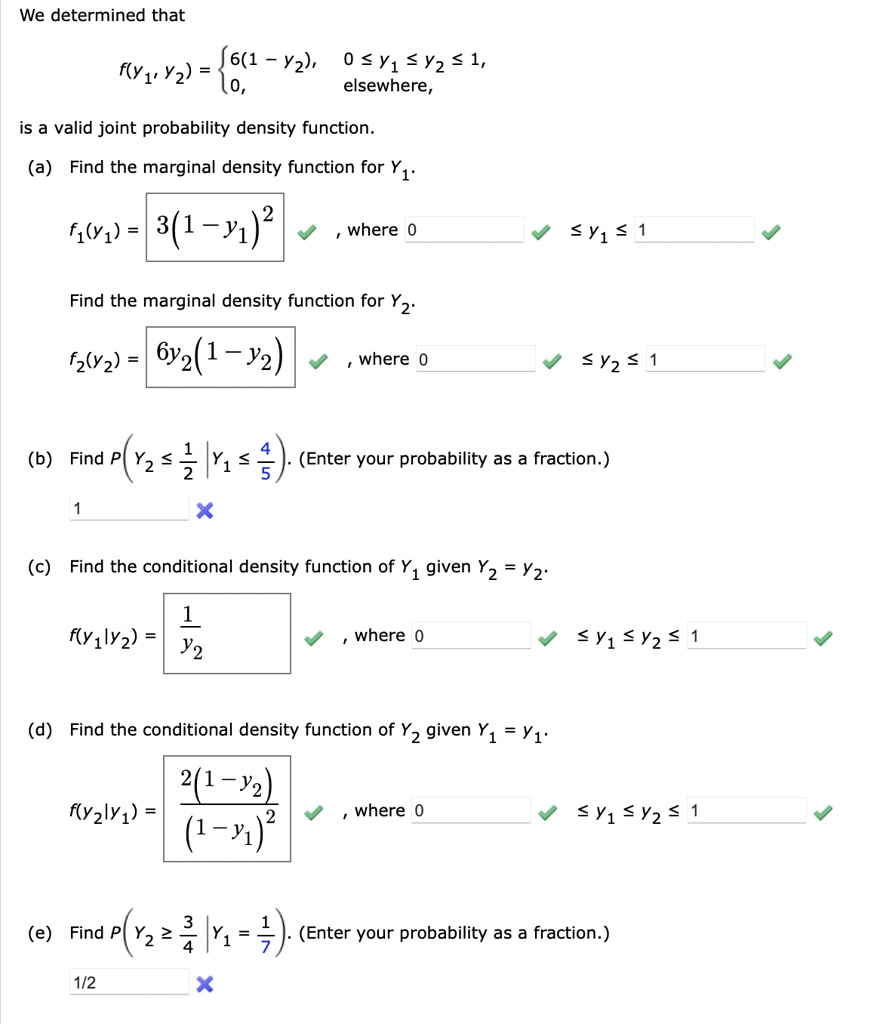
We determined that
f(y_(1),y_(2))={(6(1-y_(2)),0<=y_(1)<=y_(2)<=1,),(0, elsewhere ):}
is a valid joint probability density function.
(a) Find the marginal density function for Y_(1).
f_(1)(y_(1))=, where ,<=y_(1)<=
Find the marginal density function for Y_(2).
f_(2)(y_(2))=, where ,<=y_(2)<=
(b) Find P(Y_(2)<=(1)/(2)|Y_(1)<=(4)/(5)). (Enter your probability as a fraction.)
(c) Find the conditional density function of Y_(1) given Y_(2)=y_(2).
f(y_(1)|y_(2))=, where ,<=y_(1)<=y_(2)<=
(d) Find the conditional density function of Y_(2) given Y_(1)=y_(1).
f(y_(2)|y_(1))=(2(1-y_(2)))/((1-y_(1))^(2)), where <=y_(1)<=y_(2)<=
(e) Find P(Y_(2)>=(3)/(4)|Y_(1)=(1)/(7)). (Enter your probability as a fraction.)
We determined that
61-y 0 y1 y21 0 elsewhere,
is a valid joint probability density function
(a) Find the marginal density function for Y,
f1(y1)
where0
y11
Find the marginal density function for Y2
f2(y2)= by
,where 0
5CX5
b Find
(Enter your probability as a fraction.)
1
X
(c) Find the conditional density function of Y1 given Y2 = Y2
1 f(y1lY2)= y2
,where0
y1y21
(p)
2(1-y2) f(y2|y1)=
where 0
y1y21
e) Find P(
(Enter your probability as a fraction.)
1/2
X