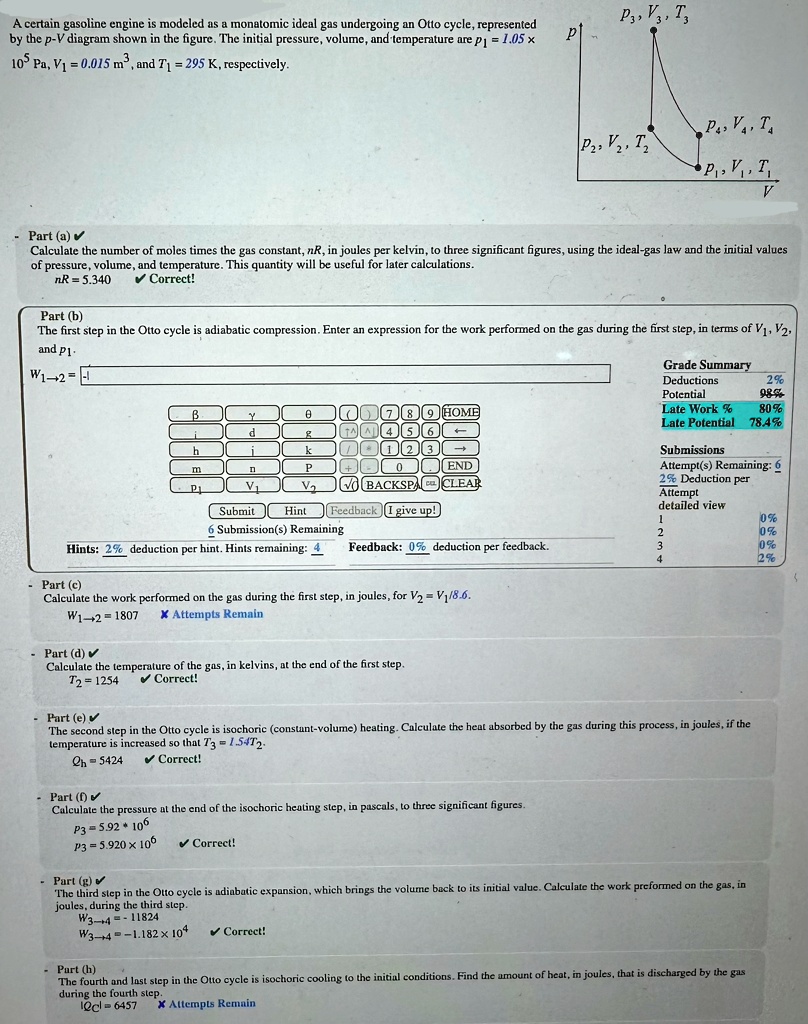
A certain gasoline engine is modeled as a monatomic ideal gas undergoing an Otto cycle, represented
by the p-V diagram shown in the figure. The initial pressure, volume, and temperature are $p_1 = 1.05 \times 10^5$ Pa, $V_1 = 0.015$ m$^3$, and $T_1 = 295$ K, respectively.
Calculate the number of moles times the gas constant, $nR$, in joules per kelvin, to three significant figures, using the ideal-gas law and the initial values of pressure, volume, and temperature. This quantity will be useful for later calculations.
$nR = 5.340$
The first step in the Otto cycle is adiabatic compression. Enter an expression for the work performed on the gas during the first step, in terms of $V_1$, $V_2$, and $p_1$.
$W_{1 \rightarrow 2} = $
Calculate the work performed on the gas during the first step, in joules, for $V_2 = V_1/8.6$.
$W_{1 \rightarrow 2} = 1807$
Calculate the temperature of the gas, in kelvins, at the end of the first step.
$T_2 = 1254$
The second step in the Otto cycle is isochoric (constant-volume) heating. Calculate the heat absorbed by the gas during this process, in joules, if the temperature is increased so that $T_3 = 1.54T_2$.
$Q_h = 5424$
Calculate the pressure at the end of the isochoric heating step, in pascals, to three significant figures.
$p_3 = 5.92 \times 10^6$
$p_3 = 5.920 \times 10^6$
The third step in the Otto cycle is adiabatic expansion, which brings the volume back to its initial value. Calculate the work preformed on the gas, in joules, during the third step.
$W_{3 \rightarrow 4} = -11824$
$W_{3 \rightarrow 4} = -1.182 \times 10^4$
The fourth and last step in the Otto cycle is isochoric cooling to the initial conditions. Find the amount of heat, in joules, that is discharged by the gas during the fourth step.
$|Q_c| = 6457$