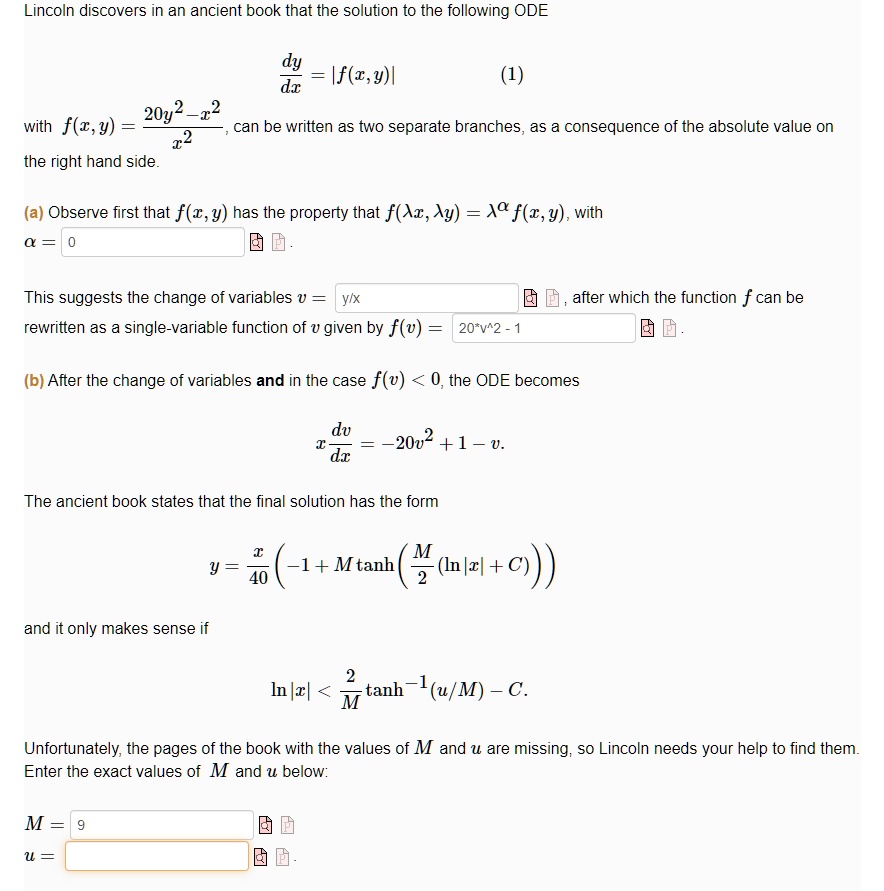
Lincoln discovers in an ancient book that the solution to the following ODE
$$
\frac{dy}{dx} = |f(x,y)|
$$
(1)
with
$$
f(x, y) = \frac{20y^2 - x^2}{x^2}
$$
, can be written as two separate branches, as a consequence of the absolute value on the right hand side.
(a) Observe first that f(x, y) has the property that f(λx, λy) = λ^α f(x, y), with
α = 0
.
This suggests the change of variables v = y/x
, after which the function f can be rewritten as a single-variable function of v given by f(v) = 20v^2 - 1
.
(b) After the change of variables and in the case f(v) < 0, the ODE becomes
$$
x \frac{dv}{dx} = -20v^2 + 1 - v.
$$
The ancient book states that the final solution has the form
$$
y = \frac{x}{40} (-1 + M \tanh(\frac{M}{2}(\ln|x| + C)))
$$
and it only makes sense if
$$
\ln|x| < \frac{2}{M} \tanh^{-1}(u/M) - C.
$$
Unfortunately, the pages of the book with the values of M and u are missing, so Lincoln needs your help to find them. Enter the exact values of M and u below:
M = 9
u =