Measuring cell sizes with an ocular micrometer
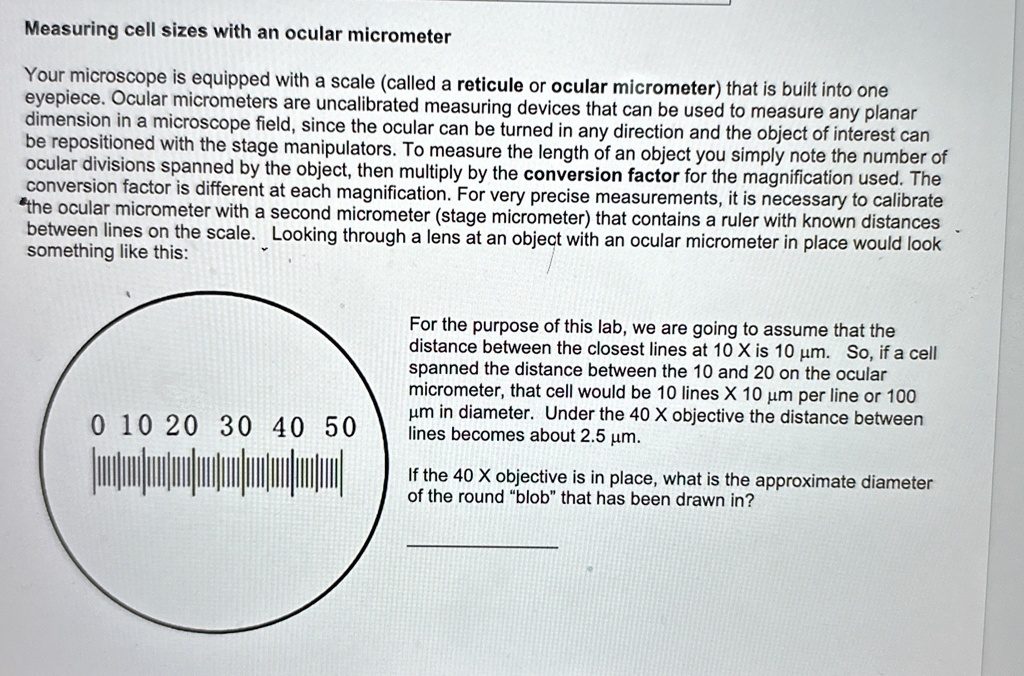
Your microscope is equipped with a scale (called a reticule or ocular micrometer) that is built into one eyepiece. Ocular micrometers are uncalibrated measuring devices that can be used to measure any planar dimension in a microscope field, since the ocular can be turned in any direction and the object of interest can be repositioned with the stage manipulators. To measure the length of an object you simply note the number of ocular divisions spanned by the object, then multiply by the conversion factor for the magnification used. The conversion factor is different at each magnification. For very precise measurements, it is necessary to calibrate the ocular micrometer with a second micrometer (stage micrometer) that contains a ruler with known distances between lines on the scale. Looking through a lens at an object with an ocular micrometer in place would look something like this:
0 10 20 30 40 50
For the purpose of this lab, we are going to assume that the distance between the closest lines at 10 X is 10 µm. So, if a cell spanned the distance between the 10 and 20 on the ocular micrometer, that cell would be 10 lines X 10 µm per line or 100 µm in diameter. Under the 40 X objective the distance between lines becomes about 2.5 µm.
If the 40 X objective is in place, what is the approximate diameter of the round "blob" that has been drawn in?