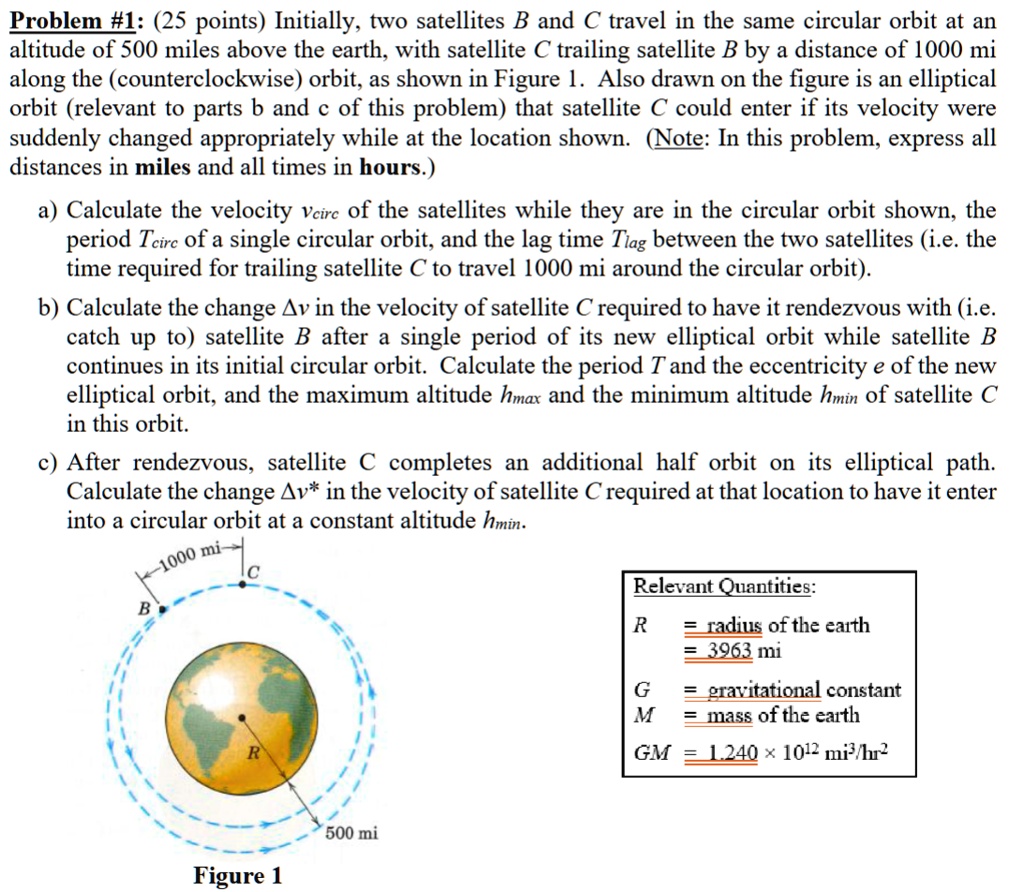
Problem #1: (25 points) Initially, two satellites B and C travel in the same circular orbit at an altitude of 500 miles above the earth, with satellite C trailing satellite B by a distance of 1000 mi along the (counterclockwise) orbit, as shown in Figure 1. Also drawn on the figure is an elliptical orbit (relevant to parts b and c of this problem) that satellite C could enter if its velocity were suddenly changed appropriately while at the location shown. (Note: In this problem, express all distances in miles and all times in hours.)
a) Calculate the velocity $v_{circ}$ of the satellites while they are in the circular orbit shown, the period $T_{circ}$ of a single circular orbit, and the lag time $T_{lag}$ between the two satellites (i.e. the time required for trailing satellite C to travel 1000 mi around the circular orbit).
b) Calculate the change $\Delta v$ in the velocity of satellite C required to have it rendezvous with (i.e. catch up to) satellite B after a single period of its new elliptical orbit while satellite B continues in its initial circular orbit. Calculate the period T and the eccentricity e of the new elliptical orbit, and the maximum altitude $h_{max}$ and the minimum altitude $h_{min}$ of satellite C in this orbit.
c) After rendezvous, satellite C completes an additional half orbit on its elliptical path. Calculate the change $\Delta v^*$ in the velocity of satellite C required at that location to have it enter into a circular orbit at a constant altitude $h_{min}$.
Figure 1
Relevant Quantities:
R = radius of the earth
= 3963 mi
G = gravitational constant
M = mass of the earth
GM = $1.240 \times 10^{12} mi^3/hr^2$