This exercise requires the use of a computer and software. Some of the answers may be calculated manually. Use a 5% significance level.
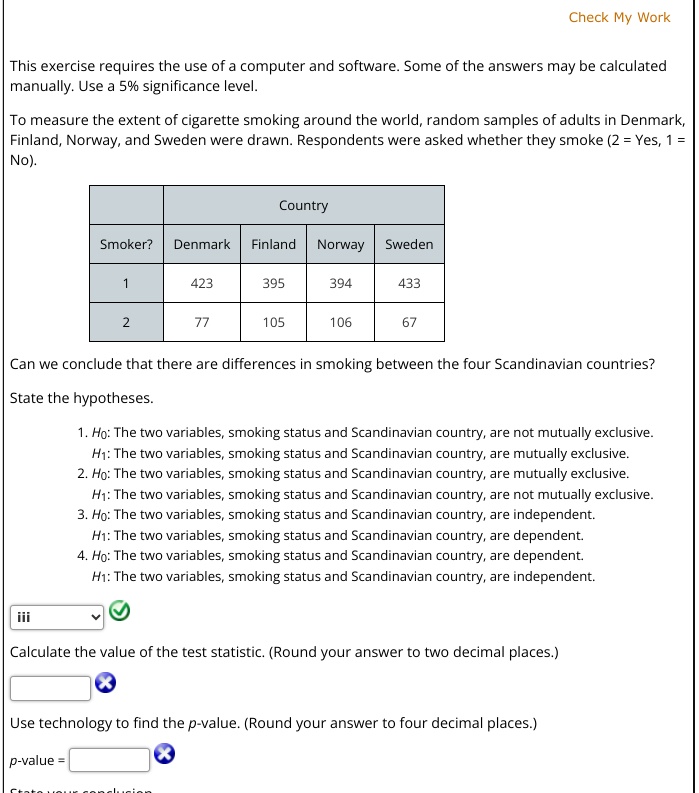
To measure the extent of cigarette smoking around the world, random samples of adults in Denmark, Finland, Norway, and Sweden were drawn. Respondents were asked whether they smoke (2 = Yes, 1 = No).
Country
Smoker? Denmark Finland Norway Sweden
1 423 395 394 433
2 77 105 106 67
Can we conclude that there are differences in smoking between the four Scandinavian countries?
State the hypotheses.
1. $H_0$: The two variables, smoking status and Scandinavian country, are not mutually exclusive.
$H_1$: The two variables, smoking status and Scandinavian country, are mutually exclusive.
2. $H_0$: The two variables, smoking status and Scandinavian country, are mutually exclusive.
$H_1$: The two variables, smoking status and Scandinavian country, are not mutually exclusive.
3. $H_0$: The two variables, smoking status and Scandinavian country, are independent.
$H_1$: The two variables, smoking status and Scandinavian country, are dependent.
4. $H_0$: The two variables, smoking status and Scandinavian country, are dependent.
$H_1$: The two variables, smoking status and Scandinavian country, are independent.
Calculate the value of the test statistic. (Round your answer to two decimal places.)
Use technology to find the p-value. (Round your answer to four decimal places.)
$p-value = $