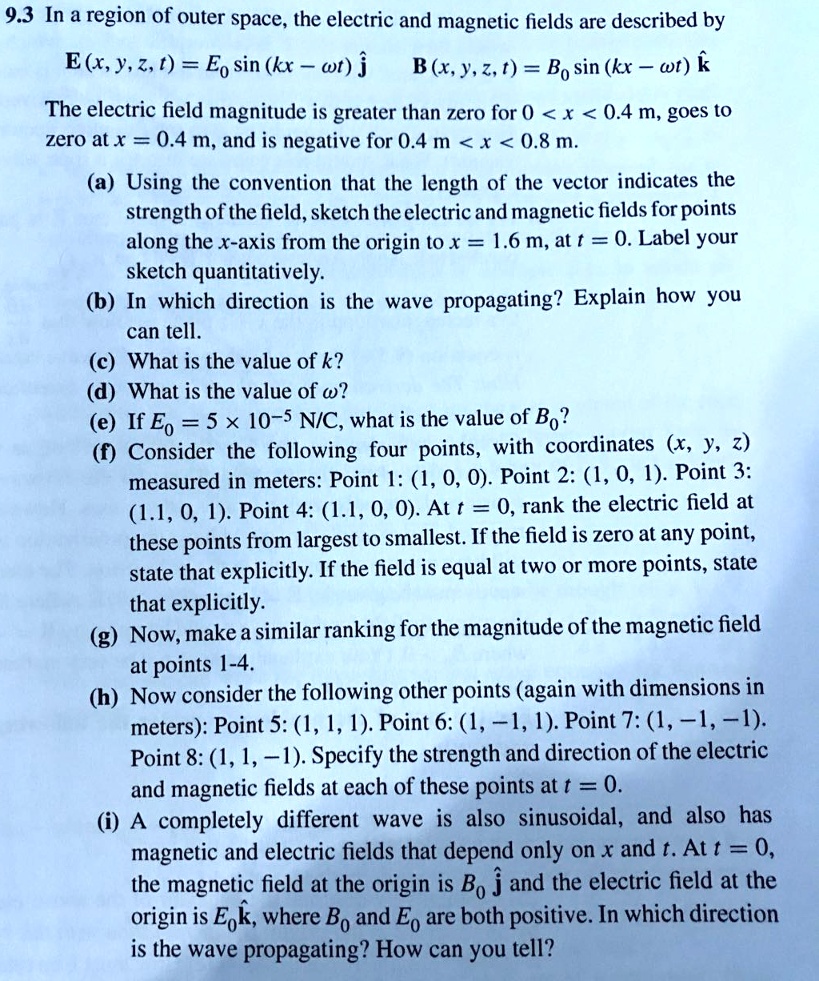
9.3 In a region of outer space, the electric and magnetic fields are described by Ex,y,z,t = Eo*sin(kx - t*j) and Bx,y,z,t = Bo*sin(kx - t*k). The electric field magnitude is greater than zero for 0 < x < 0.4 m, goes to zero at x = 0.4 m, and is negative for 0.4 m < x < 0.8 m.
(a) Using the convention that the length of the vector indicates the strength of the field, sketch the electric and magnetic fields for points along the x-axis from the origin to x = 1.6 m, at t = 0. Label your sketch quantitatively.
(b) In which direction is the wave propagating? Explain how you can tell.
(c) What is the value of k?
(d) What is the value of Eo?
(e) If Eo = 5 * 10^-5 N/C, what is the value of Bo?
(f) Consider the following four points, with coordinates (x, y, z) measured in meters:
Point 1: (1, 0, 0)
Point 2: (1, 0, 1)
Point 3: (1.1, 0, 1)
Point 4: (1.1, 0, 0)
At t = 0, rank the electric field at these points from largest to smallest. If the field is zero at any point, state that explicitly. If the field is equal at two or more points, state that explicitly.
(g) Now, make a similar ranking for the magnitude of the magnetic field at points 1-4.
(h) Now consider the following other points (again with dimensions in meters):
Point 8: (1, 1, -1)
Specify the strength and direction of the electric and magnetic fields at each of these points at t = 0.
(i) A completely different wave is also sinusoidal, and also has magnetic and electric fields that depend only on x and t. At t = 0, the magnetic field at the origin is Bo*j and the electric field at the origin is Ek, where Bo and Eo are both positive. In which direction is the wave propagating? How can you tell?