Question 10
\( 1 \mathrm{pts} \)
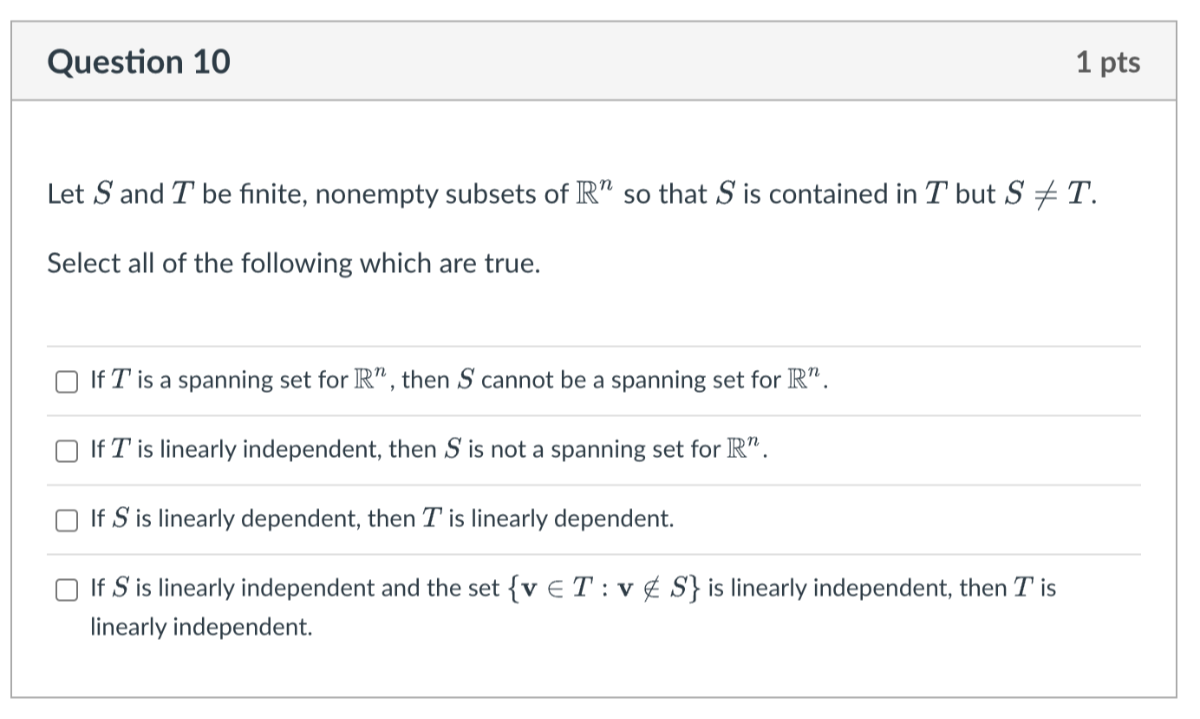
Let \( S \) and \( T \) be finite, nonempty subsets of \( \mathbb{R}^{n} \) so that \( S \) is contained in \( T \) but \( S \neq T \).
Select all of the following which are true.
If \( T \) is a spanning set for \( \mathbb{R}^{n} \), then \( S \) cannot be a spanning set for \( \mathbb{R}^{n} \).
If \( T \) is linearly independent, then \( S \) is not a spanning set for \( \mathbb{R}^{n} \).
If \( S \) is linearly dependent, then \( T \) is linearly dependent.
If \( S \) is linearly independent and the set \( \{\mathbf{v} \in T: \mathbf{v} \notin S\} \) is linearly independent, then \( T \) is linearly independent.