Ace - AI Tutor
Ask Our Educators
Textbooks
My Library
Flashcards
Scribe - AI Notes
Notes & Exams
Download App
juana hall

juana h.

Divider

Questions asked

BEST MATCH

Our genetic code affects Group of answer choices our behavioral consistency nerves, hormones, and neurotransmitters our temperament all of these

View Answer
divider
BEST MATCH

_(34)^(34)Si->_(15)^(34)P+

View Answer
divider
BEST MATCH

describe a business scenario where multiple linear regression would be more appropirate than simple linear regression

View Answer
divider
BEST MATCH

A fruit fly of genotype a + a b + b (parent 1) is crossed to another fruit fly of genotype a/a b/b (parent 2). The progeny of this cross were: Genotype Number of individuals a + a.b + b 15 a/a.b/b 12 a.b/b 34 a + a.b + b 39 The original arrangement of alleles in parent 1 would have been what?

View Answer
divider
BEST MATCH

Economists use what term to mean \"combined\" or \"total\"

View Answer
divider
BEST MATCH

1 mole of ammonia is oxidized by 1 mole of air to form nitric oxide through a reaction shown below. Find the amount of heat generated in the process at standard conditions?

View Answer
divider
BEST MATCH

Second Derivative Test Choose the most appropriate answer for each question. Drag the correct answer into each blank. fundamental theorem $y = -x^4$ $f''(d) = 0$ critical point theory does local minimum neither $f''(c) > 0$ $f''(d) < 0$ $f'(x)$ is undefined $f''(d) > 0$ second derivative test $f'(b) = 0$ $f''(b) < 0$ first derivative test $f'(d) = 0$ $f'(a)$ is undefined $f''(b) > 0$ $f'(c) = 0$ $y = x^4$ local maximum $f''(c) = 0$ does not $f''(c) < 0$ $y = x^3$ $f''(b) = 0$ For these problems, we don't know the formula for the function $f(x)$. #1. For the graph $y = f(x)$, the second derivative test guarantees that (i) The point $(c, f(c))$ is a local minimum provided that: $f'(a) = 0$ and

View Answer
divider
BEST MATCH

In Problems 1-16 find the Fourier series of $f$ on the given interval. $\qquad f(x) = \begin{cases} 0, & -\pi < x < 0 \\ \sin x, & 0 \le x < \pi \end{cases}$ 20. Use the result of Problem 9 to show that $\qquad \frac{\pi}{4} = \frac{1}{2} + \frac{1}{1 \cdot 3} - \frac{1}{3 \cdot 5} + \frac{1}{5 \cdot 7} - \frac{1}{7 \cdot 9} + \dots$

View Answer
divider
BEST MATCH

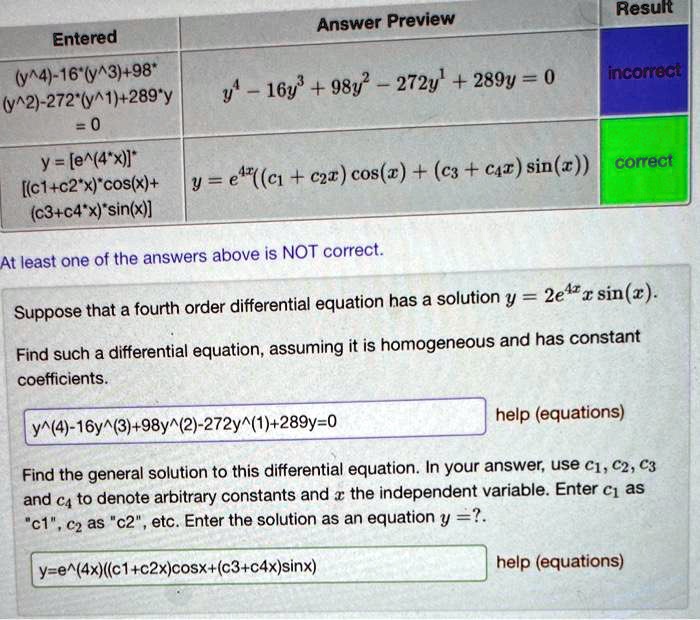
Entered (y^4)-16*(y^3)+98* (y^2)-272*(y^1)+289*y = 0 y = [e^(4*x)]* [(c1+c2*x)*cos(x)+ (c3+c4*x)*sin(x)] At least one of the answers above is NOT correct. Suppose that a fourth order differential equation has a solution y = 2e^{4x}x sin(x). Find such a differential equation, assuming it is homogeneous and has constant coefficients. y^(4)-16y^(3)+98y^(2)-272y^(1)+289y=0 Find the general solution to this differential equation. In your answer, use c1, c2, c3 and c4 to denote arbitrary constants and x the independent variable. Enter c1 as "c1", c2 as "c2", etc. Enter the solution as an equation y =?. y=e^(4x)((c1+c2x)cosx+(c3+c4x)sinx) Answer Preview y^4 - 16y^3 + 98y^2 - 272y + 289y = 0 y = e^{4x}((c1 + c2x) cos(x) + (c3 + c4x) sin(x)) Result incorrect correct help (equations) help (equations)
View Answer
divider
BEST MATCH

9. Determine the output voltage for each circuit in Figure 8-49. 10 k$\Omega$ 10 k$\Omega$ 10 k$\Omega$ +1 V +1.5 V (a) 10 k$\Omega$ +0.1 V 22 k$\Omega$ +1 V 10 k$\Omega$ +0.5 V $V_{OUT}$ 10 k$\Omega$ (b) $V_{OUT}$

View Answer
divider