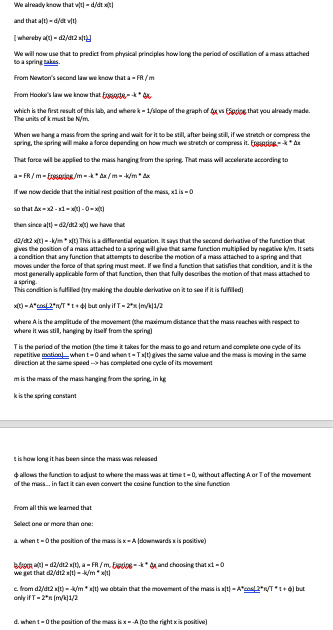
We alreade know that \( v|t|=d / \) dit \( x / 0] \)
[wheretry \( a(t]=\mathrm{d} 2 / \mathrm{di} 2 \mathrm{z} \mid \mathrm{L}] \)
We will new use that to \( p \) redict from ptrpical prindiples how long the period of eselvion of a massi attaded to a spring gahes.
frem Nowern's setand law we know that a \( =\mathrm{Ff} / \mathrm{m} \)
From hocher's law we krow that forodule \( -k \) * bly
Which is the first reselt of this lab, and where \( k=1 / \) slope of the graph of dy ns ESedec that you already made. The unici of kmest be Nim.
When we hang a mais from the iprizg and wit for it to be still, after being ast1, if we stred er cempreis the
That force will be applied to the mais hanying from the sprizg. That mais wil accelerate acterding to
If we now decide that the initial rest positien of the mask, \( x 1 \) is \( =0 \)
so that \( 2 x-x 2-x 1=x(0]-0=x(0] \)
than since a|t \( =d 2 / \) d.2 \( 2(0) \) we hawe that a condition that afy furction that attampts to descriae the motion of a mais attached to a yerifes and that mover under the force of than spring must mest. If we find a function than satifies that condition, and it ia the mest generilly applicable form of then function, then that fuly deser bes the motion of that masi attadhed to a sprife-
This cendition is faffled firy making the double derivative an it to sev if it is fufiled]
Whare \( A \) is the ampitude of the movement (ohe mudmum ditarce that the mais reacher with respoct to whare it was still, hatgires by itwelf from the sprindl
T is the period of the meticn fohe time it taloes for the mans to go and return and oomplate ene cycle of its repetitive metion _ when \( t=0 \) and when \( t=T \) a 1 gigives the same vilue and the mass is movire is the same direction at the saime speed \( \rightarrow \) has complated coe cycle of its movememt
\( \mathrm{m} \) is the mas of the mash hanging from the sprizg. in ly
\( k \) is tha sering constant
th is how long it has been since the mas wir released
\( \phi \) allows the furction to adfust to whare the masi was at time \( t=0 \), without affecting \( A \) of \( T \) of the musimant. of the mins.. in fact it can even corwert the conifa function bo tha sine fanction
from all this we leamed that
Select are or mare than afk:
a. When \( \mathrm{t}=0 \) the position of the mais is \( \mathrm{x}=\mathrm{A} \) jdewtwards \( \mathrm{x} \) is \( p \) es tive) we get that \( d 2 / d 12 n|t|=-k / m^{*} x|u| \) only if \( \mathrm{T}=2^{*} \mathrm{n}[\mathrm{m} / \mathrm{k}] 1 / 2 \)
d. whan \( t=0 \) the position of the mass i \( x=-A \) (bo the right \( x \) is positive]