Learning Goal:
To identify situations that can be modeled as an axially loaded bar and calculate the corresponding average normal stress.
In many applications, a solid bar is used to support a force along its length. This type of bar is called an axially loaded bar. When the bar is prismatic, homogenous, and
isotropic and the applied load acts through the centroid of the cross section, the regions of the bar that are not near the applied loads will deform uniformly. Many common
engineering materials, such as steel, aluminum, and other metals can be treated as homogenous and isotropic. Other materials like wood and composites are not
necessarily homogenous or isotropic. In those cases, the deformation may not be uniform and more detailed methods of analysis are required. A section is "near" an
applied load when it is closer to the load than the largest dimension of the cross section of the member.
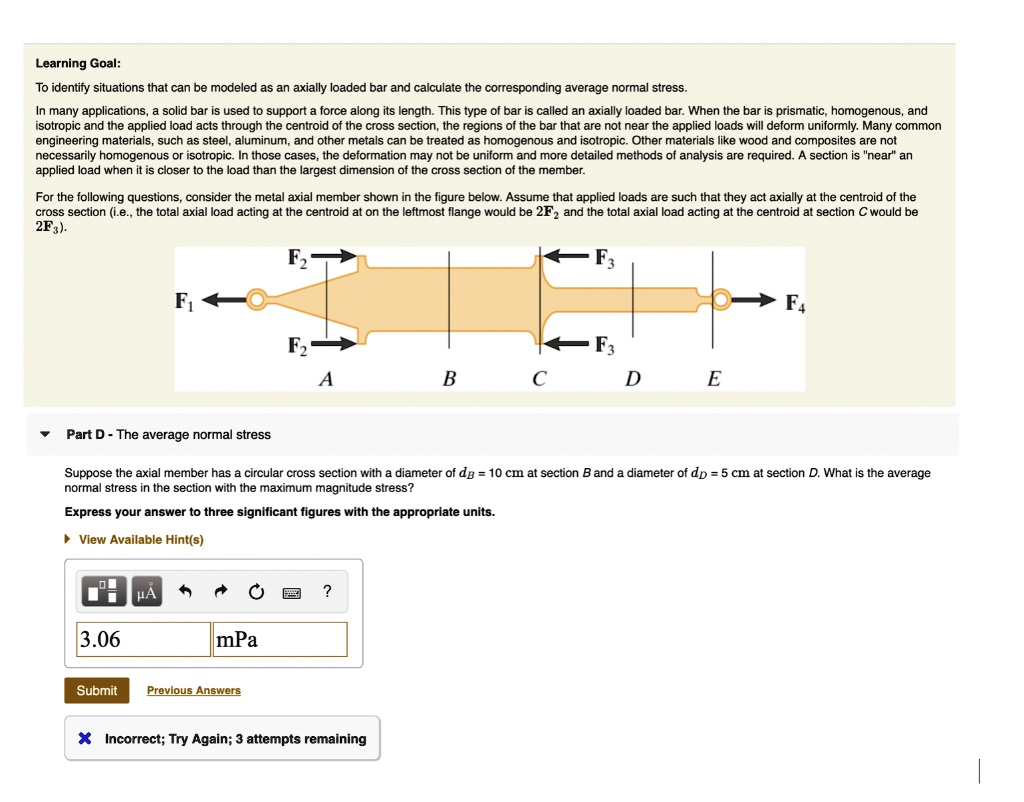
For the following questions, consider the metal axial member shown in the figure below. Assume that applied loads are such that they act axially at the centroid of the
cross section (i.e., the total axial load acting at the centroid at on the leftmost flange would be 2$F_2$ and the total axial load acting at the centroid at section C would be
2$F_3$).
Part D - The average normal stress
Suppose the axial member has a circular cross section with a diameter of $d_B = 10$ cm at section B and a diameter of $d_D = 5$ cm at section D. What is the average
normal stress in the section with the maximum magnitude stress?
Express your answer to three significant figures with the appropriate units.