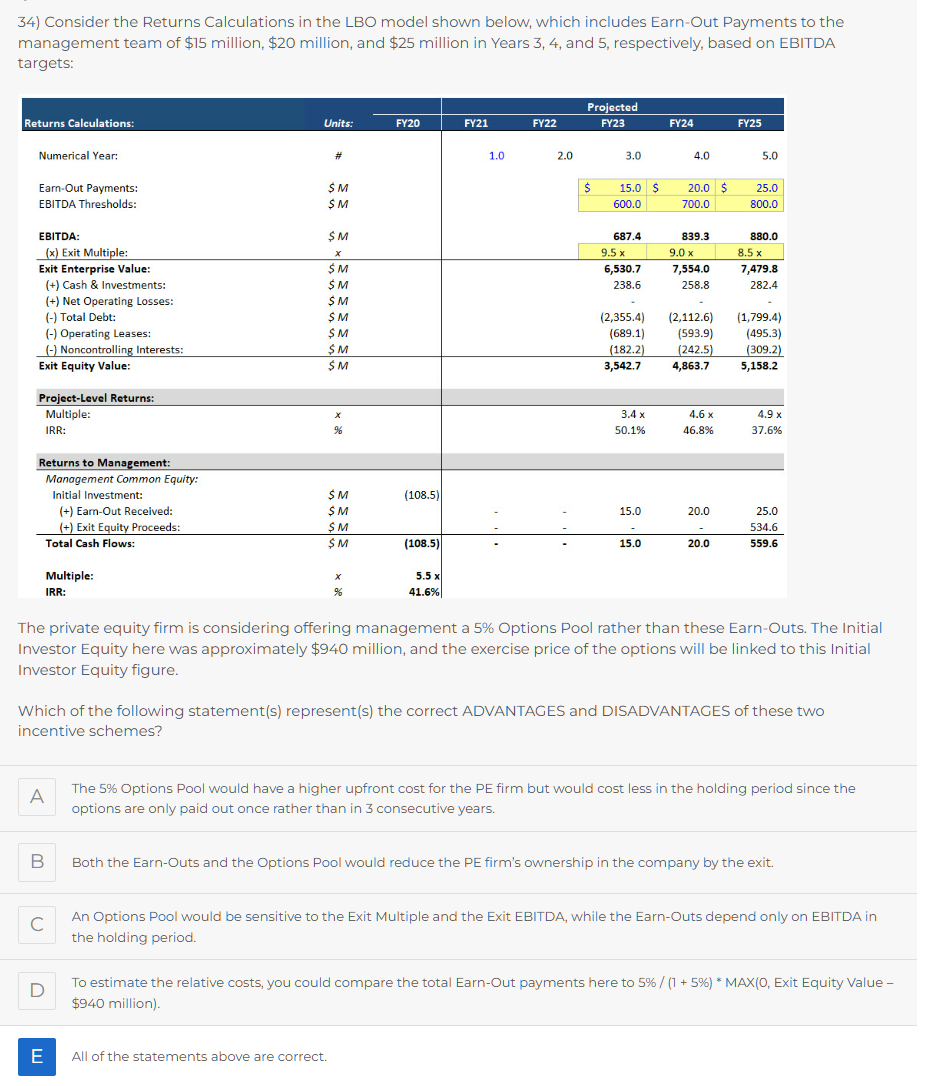
34) Consider the Returns Calculations in the LBO model shown below, which includes Earn-Out Payments to the management team of \( \$ 15 \) million, \( \$ 20 \) million, and \( \$ 25 \) million in Years 3,4 , and 5 , respectively, based on EBITDA targets:
\begin{tabular}{|c|c|c|c|c|c|c|c|c|c|}
\hline \multirow[b]{2}{*}{ Returns Calculations: } & \multirow[b]{2}{*}{ Units: } & \multirow[b]{2}{*}{ FY20 } & \multicolumn{7}{|l|}{ Projected } \\
\hline & & & FY21 & FY22 & FY23 & \multicolumn{2}{|r|}{ FY24 } & \multicolumn{2}{|r|}{ FY25 } \\
\hline Numerical Year: & \# & & 1.0 & 2.0 & 3.0 & & 4.0 & & 5.0 \\
\hline Earn-Out Payments: & \$M & & & & \$ \( \quad 15.0 \) & \$ & 20.0 & \$ & 25.0 \\
\hline EBITDA Thresholds: & \$M & & & & 600.0 & & 700.0 & & 800.0 \\
\hline EBITDA: & \$M & & & & 687.4 & & 839.3 & & 880.0 \\
\hline (x) Exit Multiple: & \( x \) & & & & \( 9.5 \times \) & & \( 9.0 \times \) & & \( 8.5 \times \) \\
\hline Exit Enterprise Value: & \$M & & & & \( 6,530.7 \) & & \( 7,554.0 \) & & \( 7,479.8 \) \\
\hline\( (+) \) Cash \& Investments: & \$M & & & & 238.6 & & 258.8 & & 282.4 \\
\hline\( (+) \) Net Operating Losses: & \$M & & & & - & & - & & - \\
\hline\( (-) \) Total Debt: & \$M & & & & \( (2,355.4) \) & & \( (2,112.6) \) & & \( (1,799.4) \) \\
\hline\( (-) \) Operating Leases: & \$M & & & & (689.1) & & (593.9) & & (495.3) \\
\hline (-) Noncontrolling Interests: & \$M & & & & (182.2) & & (242.5) & & (309.2) \\
\hline Exit Equity Value: & \$M & & & & \( 3,542.7 \) & & \( 4,863.7 \) & & \( 5,158.2 \) \\
\hline \multicolumn{10}{|l|}{ Project-Level Returns: } \\
\hline Multiple: & \( x \) & & & & \( 3.4 \times \) & & \( 4.6 \times \) & & \( 4.9 \times \) \\
\hline IRR: & \% & & & & \( 50.1 \% \) & & \( 46.8 \% \) & & \( 37.6 \% \) \\
\hline \multicolumn{10}{|l|}{ Returns to Management: } \\
\hline \multicolumn{10}{|l|}{ Management Common Equity: } \\
\hline Initial Investment: & \$M & \( (108.5) \) & & & & & & & \\
\hline\( (+) \) Earn-Out Received: & \$M & & - & - & 15.0 & & 20.0 & & 25.0 \\
\hline (+) Exit Equity Proceeds: & \$M & & - & \( \square \) & - & & - & & 534.6 \\
\hline Total Cash Flows: & \$M & (108.5) & \( \cdot \) & \( \cdot \) & 15.0 & & 20.0 & & 559.6 \\
\hline Multiple: & \( x \) & \( 5.5 \times \) & & & & & & & \\
\hline IRR: & \% & \( 41.6 \% \) & & & & & & & \\
\hline
\end{tabular}
The private equity firm is considering offering management a 5\% Options Pool rather than these Earn-Outs. The Initial Investor Equity here was approximately \( \$ 940 \) million, and the exercise price of the options will be linked to this Initial Investor Equity figure.
Which of the following statement(s) represent(s) the correct ADVANTAGES and DISADVANTAGES of these two incentive schemes?
A
The 5\% Options Pool would have a higher upfront cost for the PE firm but would cost less in the holding period since the options are only paid out once rather than in 3 consecutive years.
B
Both the Earn-Outs and the Options Pool would reduce the PE firm's ownership in the company by the exit.
C
An Options Pool would be sensitive to the Exit Multiple and the Exit EBITDA, while the Earn-Outs depend only on EBITDA in the holding period.
D
To estimate the relative costs, you could compare the total Earn-Out payments here to 5\%/(1+5\%)* MAX(O, Exit Equity Value \( \$ 940 \) million).
E
All of the statements above are correct.