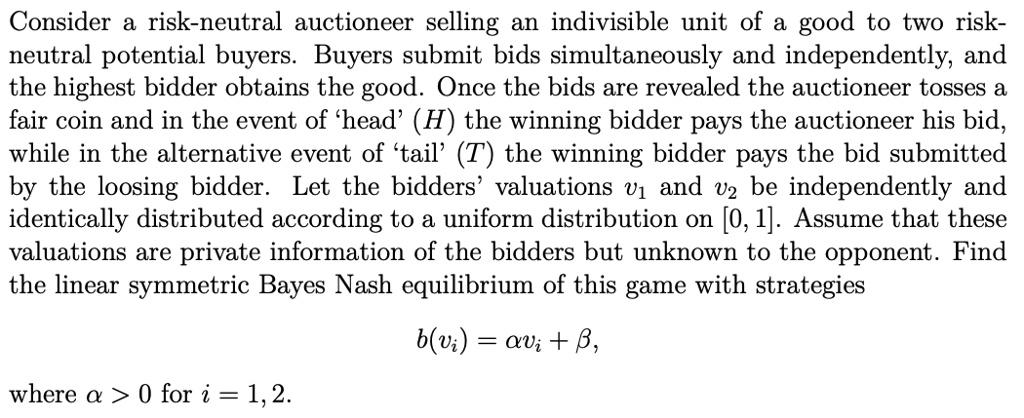
Consider a risk-neutral auctioneer selling an indivisible unit of a good to two risk- neutral potential buyers. Buyers submit bids simultaneously and independently, and the highest bidder obtains the good. Once the bids are revealed the auctioneer tosses a fair coin and in the event of ‘head’ (H) the winning bidder pays the auctioneer his bid, while in the alternative event of ‘tail’ (T) the winning bidder pays the bid submitted by the loosing bidder. Let the bidders’ valuations v1 and v2 be independently and identically distributed according to a uniform distribution on [0, 1]. Assume that these valuations are private information of the bidders but unknown to the opponent. Find the linear symmetric Bayes Nash equilibrium of this game with strategies
b(vi) = –vi + —Consider a risk-neutral auctioneer selling an indivisible unit of a good to two risk-
neutral potential buyers. Buyers submit bids simultaneously and independently, and
the highest bidder obtains the good. Once the bids are revealed the auctioneer tosses a
fair coin and in the event of 'head' (H) the winning bidder pays the auctioneer his bid,
while in the alternative event of 'tail' (T) the winning bidder pays the bid submitted
by the loosing bidder. Let the bidders' valuations v_(1) and v_(2) be independently and
identically distributed according to a uniform distribution on 0,1. Assume that these
valuations are private information of the bidders but unknown to the opponent. Find
the linear symmetric Bayes Nash equilibrium of this game with strategies
b(v_(i))=alpha v_(i)+�eta ,
where alpha >0 for i=1,2.
Consider a risk-neutral auctioneer selling an indivisible unit of a good to two risk
neutral potential buyers. Buyers submit bids simultaneously and independently, and
the highest bidder obtains the good. Once the bids are revealed the auctioneer tosses a fair coin and in the event of head' (H) the winning bidder pays the auctioneer his bid. while in the alternative event of tail' (T) the winning bidder pays the bid submitted by the loosing bidder. Let the bidders' valuations vi and v2 be independently and identically distributed according to a uniform distribution on [0, 1]. Assume that these valuations are private information of the bidders but unknown to the opponent. Find the linear symmetric Bayes Nash equilibrium of this game with strategies
b(vi) = avi+B
where a > 0 for i =1,2.