2. Uniqueness of Solutions
Informal Uniqueness Theorem: Suppose we want to know if the solution curves/time series plots for a particular
change equation $u'(t) = f(t, u(t))$ are unique. That is, we have decided on a region of the $u-t$ plane that we care
about.
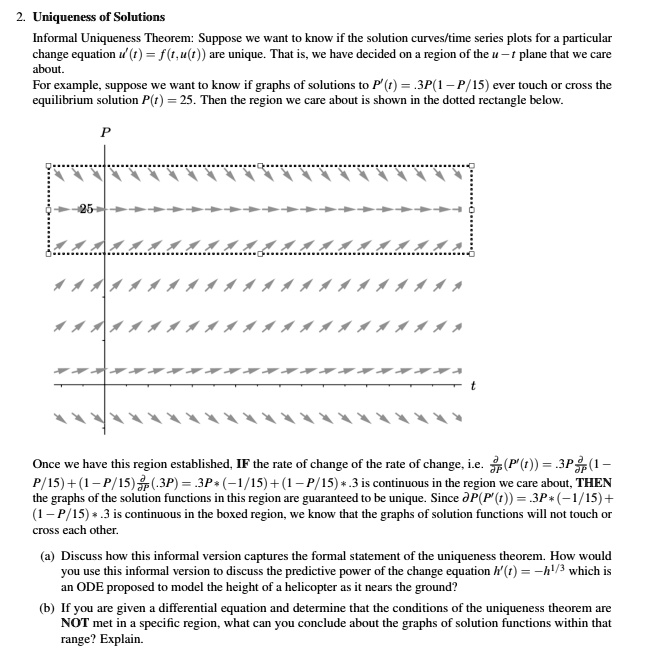
For example, suppose we want to know if graphs of solutions to $P'(t) = 3P(1 - P/15)$ ever touch or cross the
equilibrium solution $P(t) = 25$. Then the region we care about is shown in the dotted rectangle below.
P
25
t
Once we have this region established, IF the rate of change of the rate of change, i.e. $�rac{d}{dt}P'(t) = 3P(1 -
P/15) + (1 - P/15)(.3P) = 3P(-1/15) + (1 - P/15) * .3$ is continuous in the region we care about, THEN
the graphs of the solution functions in this region are guaranteed to be unique. Since $�rac{d}{dt}P'(t) = .3P*(-1/15) +
(1 - P/15)*.3$ is continuous in the boxed region, we know that the graphs of solution functions will not touch or
cross each other.
(a) Discuss how this informal version captures the formal statement of the uniqueness theorem. How would
you use this informal version to discuss the predictive power of the change equation $h'(t) = -h^{1/3}$ which is
an ODE proposed to model the height of a helicopter as it nears the ground?
(b) If you are given a differential equation and determine that the conditions of the uniqueness theorem are
NOT met in a specific region, what can you conclude about the graphs of solution functions within that
range? Explain.