QUESTION 46
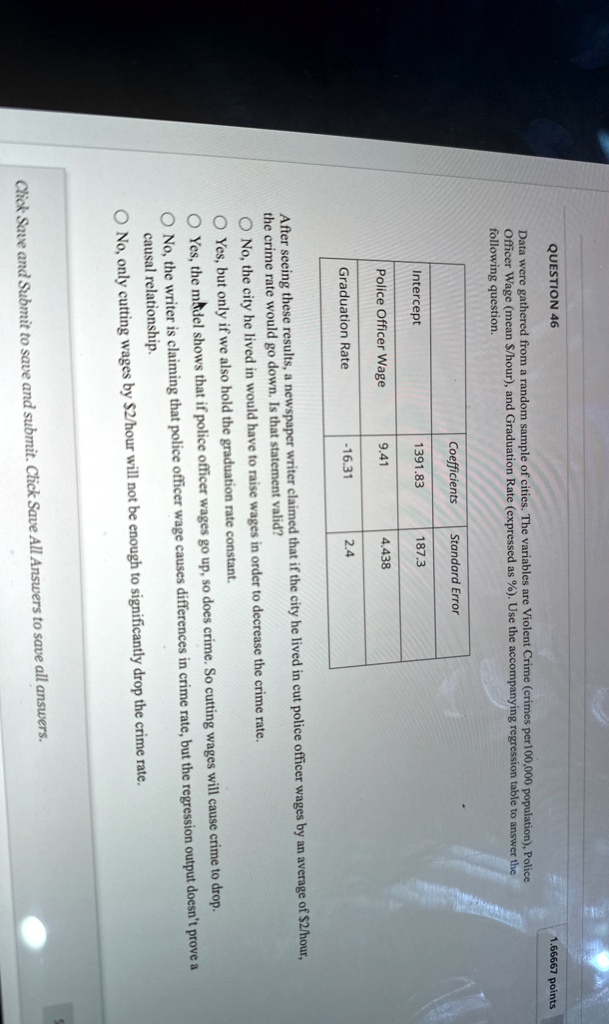
Data were gathered from a random sample of cities. The variables are Violent Crime (crimes per100,000 population), Police Officer Wage (mean $/hour), and Graduation Rate (expressed as %). Use the accompanying regression table to answer the following question.
Coefficients Standard Error
Intercept 1391.83 187.3
Police Officer Wage 9.41 4.438
Graduation Rate -16.31 2.4
After seeing these results, a newspaper writer claimed that if the city he lived in cut police officer wages by an average of $2/hour, the crime rate would go down. Is that statement valid?
No, the city he lived in would have to raise wages in order to decrease the crime rate.
Yes, but only if we also hold the graduation rate constant.
Yes, the model shows that if police officer wages go up, so does crime. So cutting wages will cause crime to drop.
No, the writer is claiming that police officer wage causes differences in crime rate, but the regression output doesn't prove a causal relationship.
No, only cutting wages by $2/hour will not be enough to significantly drop the crime rate.