Ace - AI Tutor
Ask Our Educators
Textbooks
My Library
Flashcards
Scribe - AI Notes
Notes & Exams
Download App
julia murray

julia m.

Divider

Questions asked

BEST MATCH

A college is trying to determine if there is a significant difference in the mean GMAT score of students from different undergraduate backgrounds who apply to the MBA program. The accompanying GMAT Scores data comes from a sample of students. What conclusion can be reached using ANOVA? Business 572 594 582 583 584 599 570 565 591 606 590 579 588 Liberal Arts 567 577 581 569 561 577 578 Sciences 601 595 586 594 597 583 595 592 610 575 606 596 594 615 594 607 586 586

View Answer
divider
BEST MATCH

What is the amount of Rick and Sara's NOL for 2024?

View Answer
divider
BEST MATCH

Externalities are ? the costs associated with an economic activity that affect people not directly involved in that activity ? costs that they are reflected in prices ? costs of production or consumption that accrue only to participants in market transactions ? costs that include the private costs of economic activity

View Answer
divider
BEST MATCH

3. Who developed the first vaccine for smallpox? a) Edward Jenner b) Gregor Mendel c) Louis Pasteur d) Charles Darwin 4. Who first described the process of fertilization in animals? a) Albert von ker

View Answer
divider
BEST MATCH

True

View Answer
divider
BEST MATCH

Based on the above, if the following peptide is cleaved by trypsin, which amino acid will be on the new N-terminus and how many fragments will result: AGRQKFYFK?

View Answer
divider
BEST MATCH

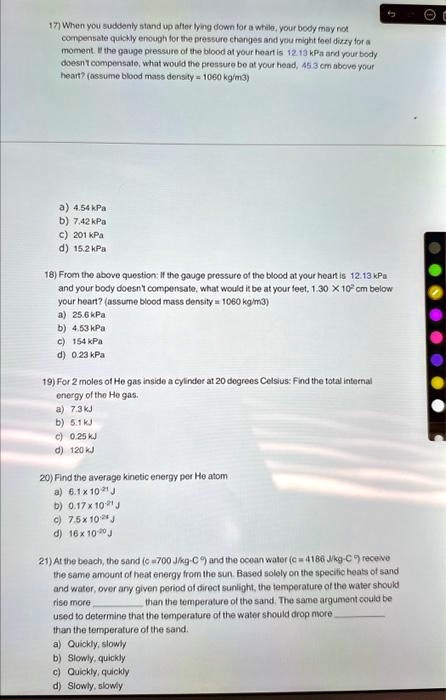
17) When you suddenly stand up after lying down for a while, your body may not compensate quickly enough for the pressure changes and you might feel dizzy for a moment. If the gauge pressure of the blood at your heart is 12.13 kPa and your body doesn't compensate, what would the pressure be at your head, 45.3 cm above your heart? (assume blood mass density = 1060 kg/m3) 5 ? a) 4.54 kPa b) 7.42 kPa c) 201 kPa d) 15.2 kPa 18) From the above question: If the gauge pressure of the blood at your heart is 12.13 kPa and your body doesn't compensate, what would it be at your feet, 1.30 \times 10^2 cm below your heart? (assume blood mass density = 1060 kg/m3) a) 25.6 kPa b) 4.53 kPa c) 154 kPa d) 0.23 kPa 19) For 2 moles of He gas inside a cylinder at 20 degrees Celsius: Find the total internal energy of the He gas. a) 7.3 kJ b) 5.1 kJ c) 0.25 kJ d) 120 kJ 20) Find the average kinetic energy per He atom a) $6.1 \times 10^{-21}$ J b) $0.17 \times 10^{-21}$ J c) $7.5 \times 10^{-20}$ J d) $16 \times 10^{-20}$ J 21) At the beach, the sand (c ?700 J/kg-C°) and the ocean water (c = 4186 J/kg-C°) receive the same amount of heat energy from the sun. Based solely on the specific heats of sand and water, over any given period of direct sunlight, the temperature of the water should rise more ____ than the temperature of the sand. The same argument could be used to determine that the temperature of the water should drop more ____ than the temperature of the sand. a) Quickly, slowly b) Slowly, quickly c) Quickly, quickly d) Slowly, slowly
View Answer
divider
BEST MATCH

11. What bones are involved in the distal tibiofibular joint? 12. What bones are involved in the subtalar joint? 13. List the motions of the ankle. 14. What axis of rotation does plantar flexion and dorsiflexion occur about?

View Answer
divider
BEST MATCH

For the SCARA robot as shown below: a) Derive the corresponding D-H parameters for the robot. b) Determine the transformation matrices $T_i^{i-1}$ for $i = 1, 2, 3$ and final transformation matrix $T_0^3$. c) If values $L_1, L_2, L_3$, and $O_3 = (P_x, P_y, P_z)$ are known; derive expressions for determining $\theta_1, \theta_2$, and $d$.

View Answer
divider
BEST MATCH

-14 H H Na A. H 14 A 4 ClO 4-9 4 ?? 11- A tl Na HH HA a + B. H. H O_H A-9 It H HH H 14 C. 1 O H H 14 H A H 14 H H 14 H Na H 4 D. H-QH -14 H "OH-0 C HH ??? H ?? H

View Answer
divider