EXCEL WORKBOOKS
First, you create a table showing the conversion factors from hobbits to the other units,
including comments documenting the conversion. You then use these calculated conversion
factors to create the rest of the table.
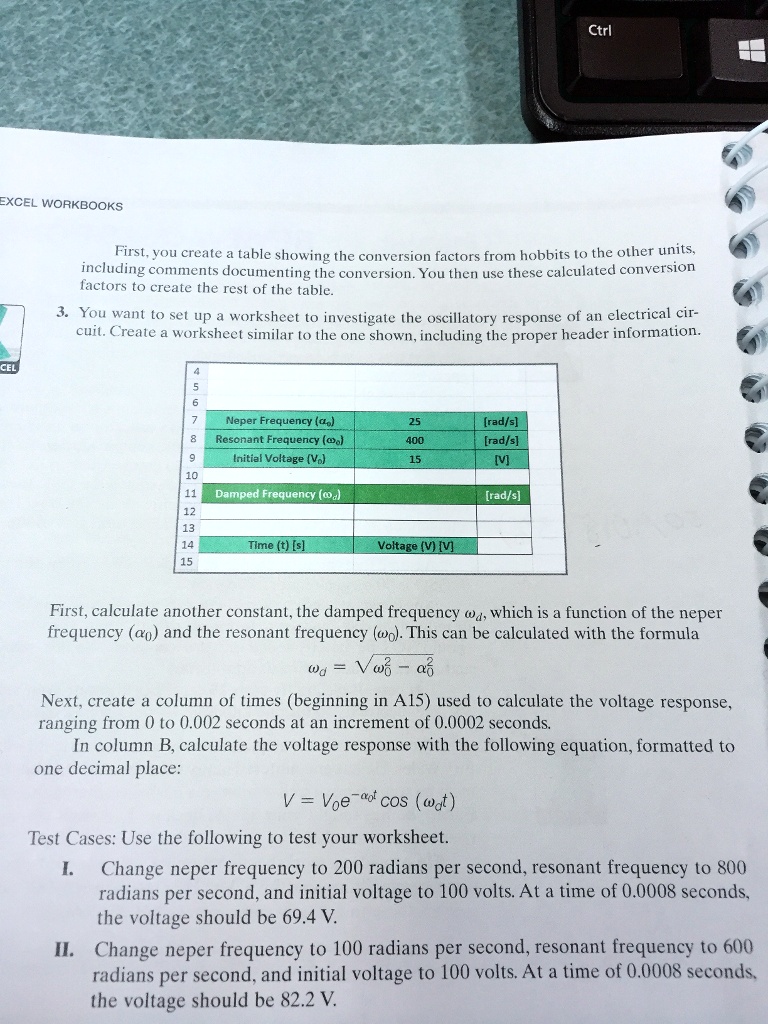
3. You want to set up a worksheet to investigate the oscillatory response of an electrical cir-
cuit. Create a worksheet similar to the one shown, including the proper header information.
4
5
6
7
Neper Frequency ($\alpha_d$)
25
[rad/s]
8
Resonant Frequency ($\omega_o$)
400
[rad/s]
9
Initial Voltage ($V_o$)
15
[V]
10
11
Damped Frequency ($\omega_d$)
[rad/s]
12
13
14
15
Time (t) [s]
Voltage (V) [V]
First, calculate another constant, the damped frequency $\omega_d$, which is a function of the neper
frequency ($\alpha_d$) and the resonant frequency ($\omega_o$). This can be calculated with the formula
$\omega_d = \sqrt{\omega_o^2 - \alpha_d^2}$
Next, create a column of times (beginning in A15) used to calculate the voltage response,
ranging from 0 to 0.002 seconds at an increment of 0.0002 seconds.
In column B, calculate the voltage response with the following equation, formatted to
one decimal place:
$V = V_oe^{-\alpha_dt} cos (\omega_dt)$
Test Cases: Use the following to test your worksheet.
I. Change neper frequency to 200 radians per second, resonant frequency to 800
radians per second, and initial voltage to 100 volts. At a time of 0.0008 seconds,
the voltage should be 69.4 V.
II. Change neper frequency to 100 radians per second, resonant frequency to 600
radians per second, and initial voltage to 100 volts. At a time of 0.0008 seconds,
the voltage should be 82.2 V.