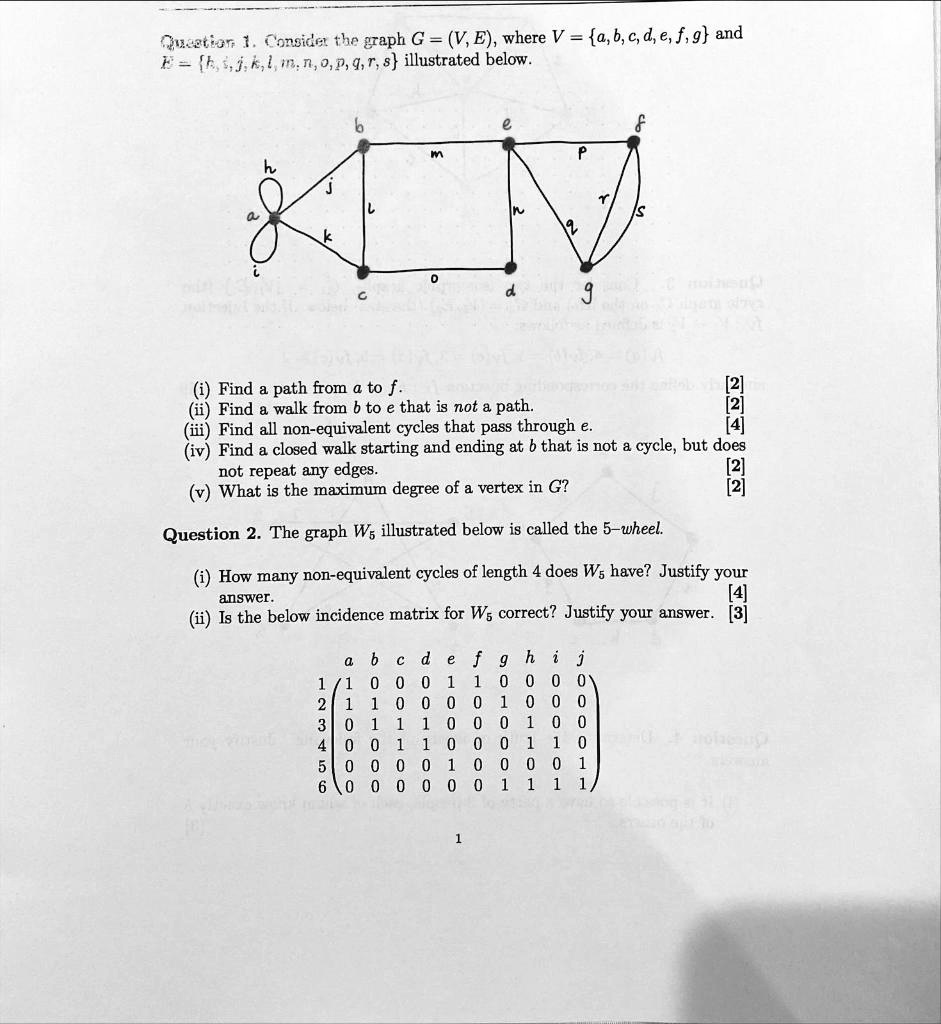
Question 1. Consider the graph G = (V, E), where V = {a, b, c, d, e, f, g} and
E = {h, i, j, k, l, m, n, o, p, q, r, s} illustrated below.
b
e
h
j
m
p
a
k
l
o
d
g
(i) Find a path from a to f.
[2]
(ii) Find a walk from b to e that is not a path.
[2]
(iii) Find all non-equivalent cycles that pass through e.
[4]
(iv) Find a closed walk starting and ending at b that is not a cycle, but does
not repeat any edges.
[2]
(v) What is the maximum degree of a vertex in G?
[2]
Question 2. The graph $W_5$ illustrated below is called the 5-wheel.
(i) How many non-equivalent cycles of length 4 does $W_5$ have? Justify your
answer.
[4]
(ii) Is the below incidence matrix for $W_5$ correct? Justify your answer. [3]
a b c d e f g h i j
1 1 0 0 0 1 1 0 0 0
2 1 1 0 0 0 0 1 0 0
3 0 1 1 1 0 0 0 1 0 0
4 0 0 1 1 0 0 0 1 1 0
5 0 0 0 0 1 0 0 0 0 1
6 0 0 0 0 0 0 1 1 1 1