Ace - AI Tutor
Ask Our Educators
Textbooks
My Library
Flashcards
Scribe - AI Notes
Notes & Exams
Download App
julia vi-as

julia v.

Divider

Questions asked

BEST MATCH

What organ is most affected by amatoxins? A) heart B) lungs C) kidney D) liver E) pancreas

View Answer
divider
BEST MATCH

Question 1 1 pts Which of the following bones compose the pelvic girdle. (Select all that apply) scapula clavicle pubis ilium humerus

View Answer
divider
BEST MATCH

What is the condition called where a proximal portion of the stomach pushes through an opening in the diaphragm, allowing stomach acid to pass into the esophagus? ? hiatal hernia ? dyspepsia ? dysphagia ? esophageal varices

View Answer
divider
BEST MATCH

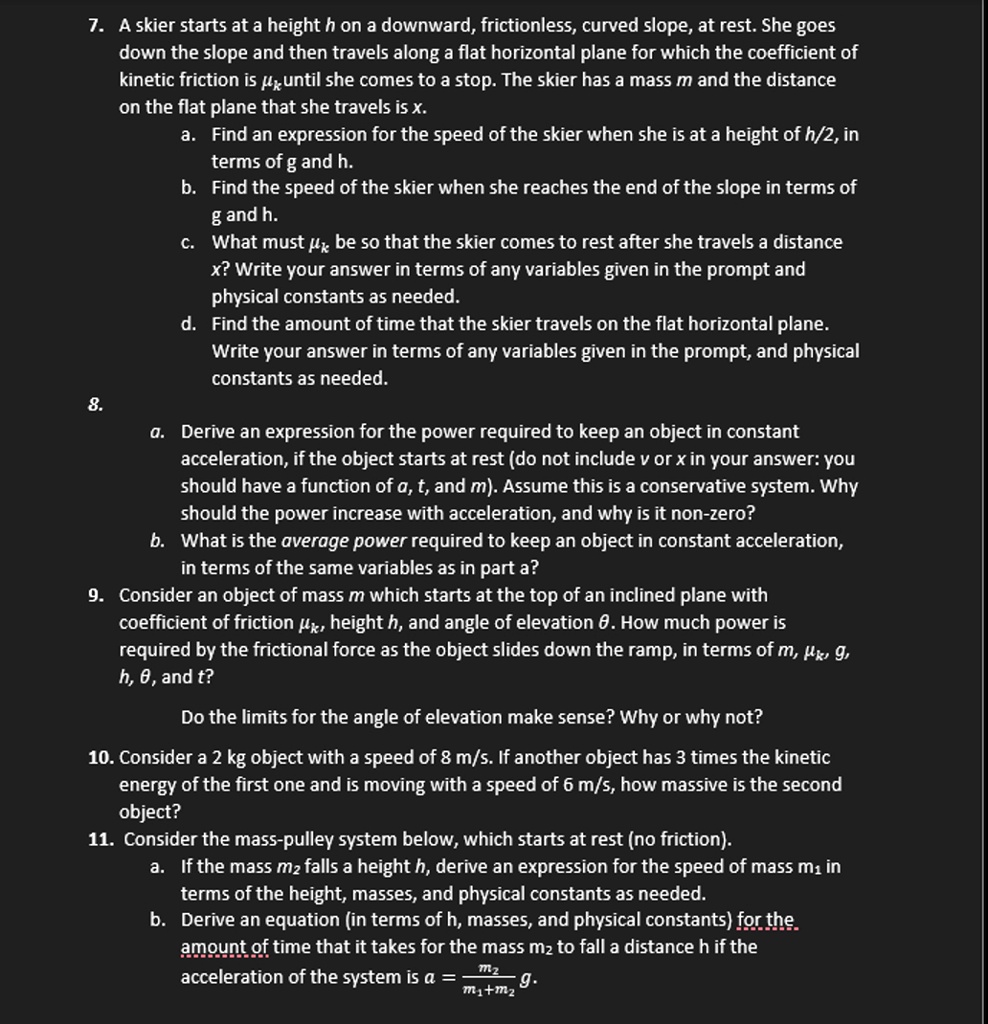
7. A skier starts at a height h on a downward, frictionless, curved slope, at rest. She goes down the slope and then travels along a flat horizontal plane for which the coefficient of kinetic friction is $\mu_k$ until she comes to a stop. The skier has a mass m and the distance on the flat plane that she travels is x. a. Find an expression for the speed of the skier when she is at a height of h/2, in terms of g and h. b. Find the speed of the skier when she reaches the end of the slope in terms of g and h. c. What must $\mu_k$ be so that the skier comes to rest after she travels a distance x? Write your answer in terms of any variables given in the prompt and physical constants as needed. d. Find the amount of time that the skier travels on the flat horizontal plane. Write your answer in terms of any variables given in the prompt, and physical constants as needed. 8. a. Derive an expression for the power required to keep an object in constant acceleration, if the object starts at rest (do not include v or x in your answer: you should have a function of a, t, and m). Assume this is a conservative system. Why should the power increase with acceleration, and why is it non-zero? b. What is the average power required to keep an object in constant acceleration, in terms of the same variables as in part a? 9. Consider an object of mass m which starts at the top of an inclined plane with coefficient of friction $\mu_k$, height h, and angle of elevation $\theta$. How much power is required by the frictional force as the object slides down the ramp, in terms of m, $\mu_k$, g, h, $\theta$, and t? Do the limits for the angle of elevation make sense? Why or why not? 10. Consider a 2 kg object with a speed of 8 m/s. If another object has 3 times the kinetic energy of the first one and is moving with a speed of 6 m/s, how massive is the second object? 11. Consider the mass-pulley system below, which starts at rest (no friction). a. If the mass $m_2$ falls a height h, derive an expression for the speed of mass $m_1$ in terms of the height, masses, and physical constants as needed. b. Derive an equation (in terms of h, masses, and physical constants) for the amount of time that it takes for the mass $m_2$ to fall a distance h if the acceleration of the system is a = $\frac{m_2}{m_1+m_2}g$.
View Answer
divider
BEST MATCH

Match the following terms to the correct definition or function lgG T cells B cells lgM a. Matures in the bone marrow and develops into antibody producing cells or memory cells b. The most abundant class of immunoglobulins and accounts for most of the protective activity against infection c. A type of B cell and a first responder in the immune system d. Provide cellular immunity and consist of CD4 and CD8 cells

View Answer
divider
BEST MATCH

Gary and Ollinger are partners who share profits and losses equally and have balances of $283,800 and $244,700 respectively parks is admitted into the partnership by investing 2$44,700 for 30% interest account balance of all your capital after the admission of parks would be

View Answer
divider
BEST MATCH

2. (1) Find the sum: \( 3 \cdot 5+5 \cdot 7+\cdots+(2 n-1) \cdot(2 n+1) \) \( (10 \%) \) (2) Find the limit: \( \lim _{n \rightarrow \infty} \frac{3 \cdot 5+5 \cdot 7+\cdots+(2 n-1) \cdot(2 n+1)}{n^{3}} \) \( (10 \%) \) 3. Find the definite integral: \( (30 \%) \) (1) \( \int_{0}^{\pi / 2}(1-2 \cos \theta+3 \sin \theta) d \theta \). (2) \( \int_{0}^{-1} \frac{u-1}{\sqrt{u+1}} d u \). (3) \( \int_{-1}^{3}(x-2|-| x+2) d x \). 4. (1) Find the Riemann sum of the function \( f(x)=1+3 x^{2} \) on the clo regular partition \( (1086) \) (2) Whe the result of (1) to find the area of the region by the ger che the vertical lines \( x=1 \) and \( x=2 \) by the limit defini then thental theorem of calculus to find th \( (10 \%) \)

View Answer
divider
BEST MATCH

Solve: \log_{21}(x-3) = 1 - \log_{21}(x+1) Exact answers only, NO CALCULATOR!

View Answer
divider
BEST MATCH

Question 16 The effects of COVID-19 pandemic on trade, economies, travel, and relations around world is an example of the impact of ________. gentrification globalization urbanization

View Answer
divider
BEST MATCH

How would you determine if a particular psychological treatment is effective?

View Answer
divider