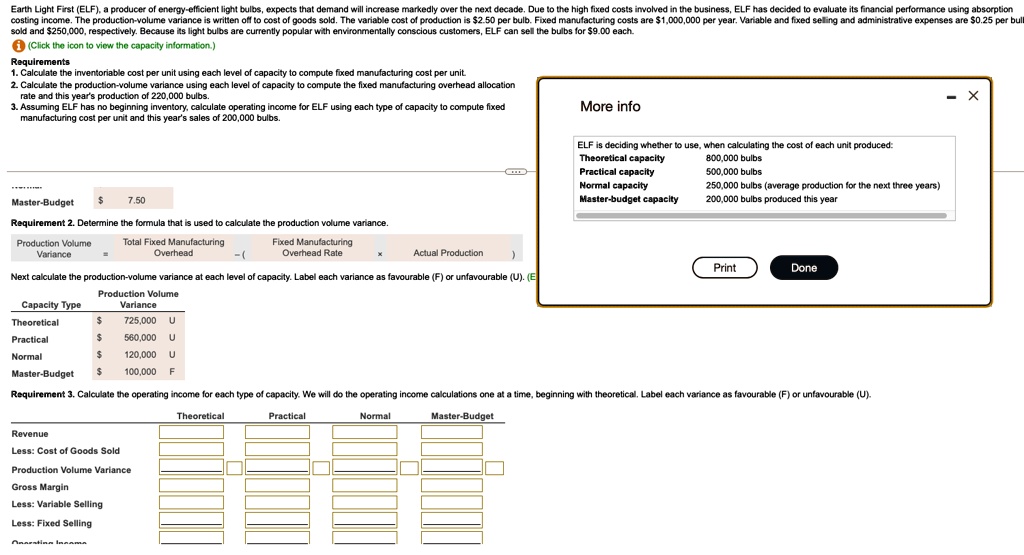
Earth Light First (ELF), a producer of energy-efficient light bulbs, expects that demand will increase markedly over the next decade. Due to the high fixed costs involved in the business, ELF has decided to evaluate its financial performance using absorption
costing income. The production-volume variance is written off to cost of goods sold. The variable cost of production is $2.50 per bulb. Fixed manufacturing costs are $1,000,000 per year. Variable and fixed selling and administrative expenses are $0.25 per bull
sold and $250,000, respectively. Because its light bulbs are currently popular with environmentally conscious customers, ELF can sell the bulbs for $9.00 each.
1 (Click the icon to view the capacity information.)
Requirements
1. Calculate the inventoriable cost per unit using each level of capacity to compute fixed manufacturing cost per unit.
2. Calculate the production-volume variance using each level of capacity to compute the fixed manufacturing overhead allocation
rate and this year's production of 220,000 bulbs.
3. Assuming ELF has no beginning inventory, calculate operating income for ELF using each type of capacity to compute fixed
manufacturing cost per unit and this year's sales of 200,000 bulbs.
Master-Budget
$
7.50
More info
ELF is deciding whether to use, when calculating the cost of each unit produced:
Theoretical capacity
Practical capacity
Normal capacity
Master-budget capacity
800,000 bulbs
500,000 bulbs
250,000 bulbs (average production for the next three years)
200,000 bulbs produced this year
X
Requirement 2. Determine the formula that is used to calculate the production volume variance.
Production Volume Total Fixed Manufacturing
Variance
Overhead
-(
Fixed Manufacturing
Overhead Rate
Actual Production
)
Next calculate the production-volume variance at each level of capacity. Label each variance as favourable (F) or unfavourable (U). (E
Production Volume
Capacity Type
Variance
Theoretical
$
725.000 U
Practical
$
560,000 บ
Normal
$
120,000 U
Master-Budget
$
100,000 F
Print
Done
Requirement 3. Calculate the operating income for each type of capacity. We will do the operating income calculations one at a time, beginning with theoretical. Label each variance as favourable (F) or unfavourable (U).
Revenue
Less: Cost of Goods Sold
Production Volume Variance
Gross Margin
Less: Variable Selling
Less: Fixed Selling
Theoretical
Practical
Normal
Master-Budget