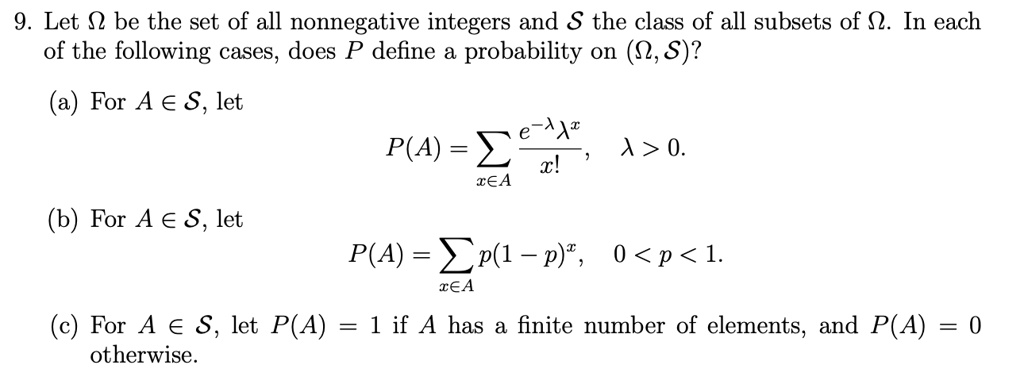
9. Let $\Omega$ be the set of all nonnegative integers and $\mathcal{S}$ the class of all subsets of $\Omega$. In each of the following cases, does $P$ define a probability on $(\Omega, \mathcal{S})$?
(a) For $A \in \mathcal{S}$, let
$P(A) = \sum_{x \in A} \frac{e^{-\lambda}\lambda^x}{x!}$, $\lambda > 0$.
(b) For $A \in \mathcal{S}$, let
$P(A) = \sum_{x \in A} p(1-p)^x$, $0 < p < 1$.
(c) For $A \in \mathcal{S}$, let $P(A) = 1$ if $A$ has a finite number of elements, and $P(A) = 0$ otherwise.