Ace - AI Tutor
Ask Our Educators
Textbooks
My Library
Flashcards
Scribe - AI Notes
Notes & Exams
Download App
julian hill

julian h.

Divider

Questions asked

BEST MATCH

Dr. Angeletti goes to the physician for an office visit. She has a $20 co-pay, a 10% co-insurance, and an allowed amount of $400, what does she pay out-of-pocket? ◻ $0 - She owes nothing ◻ $20 ◻ $40 ◻ $60

View Answer
divider
BEST MATCH

Evaluate the following integral. \[ \int \frac{2 x+1}{x^{2}+9} d x \]

View Answer
divider
BEST MATCH

The following ketoacid is involved in fixing dietary NH into amino acid: A. Pyruvate B. Glutamine C. Glutamate D. Arginosuccinate E. Oxaloacetate F. Oxalosuccinate G. a-ketoglutarate

View Answer
divider
BEST MATCH

Question 11 (1 point) The highlighted part in this interface is designed for: avoiding modes engineering for errors optimizing operation simplicity and consistency

View Answer
divider
BEST MATCH

Use the given conditions. sin(u) = 3 5 , 𝜋 2 < u < 𝜋 (a) Determine the quadrant in which u/2 lies. Quadrant I Quadrant II Quadrant III Quadrant IV Correct: Your answer is correct. Way to go! (b) Find the exact values of sin(u/2), cos(u/2), and tan(u/2) using the half-angle formulas. sin(u/2) = cos(u/2) = tan(u/2) =

View Answer
divider
BEST MATCH

List out three (3) types of BJT circuit configurations. Draw the I-V characteristic curve of a common-emitter BJT and indicate on the curve all the operating regions. A high sensor water module in Figure 6 below uses a silicon based bipolar junction transistor to make a relay 12Vdc energize and function. The operation of the circuit is as follows: When sensor detects water, switch is closed and the transistor will 'ON'. The relay then will be energized. Given $\beta$ = 60, determine $I_B$, $I_C$, $I_E$, $V_{BE}$, $V_{CE}$ and $V_{CB}$. $V_{BB}$ = 7V RELAY $R_C = 2.4 k\Omega$ High Sensor Water $R_B = 420 k\Omega$ $V_{CC}$ = 14V

View Answer
divider
BEST MATCH

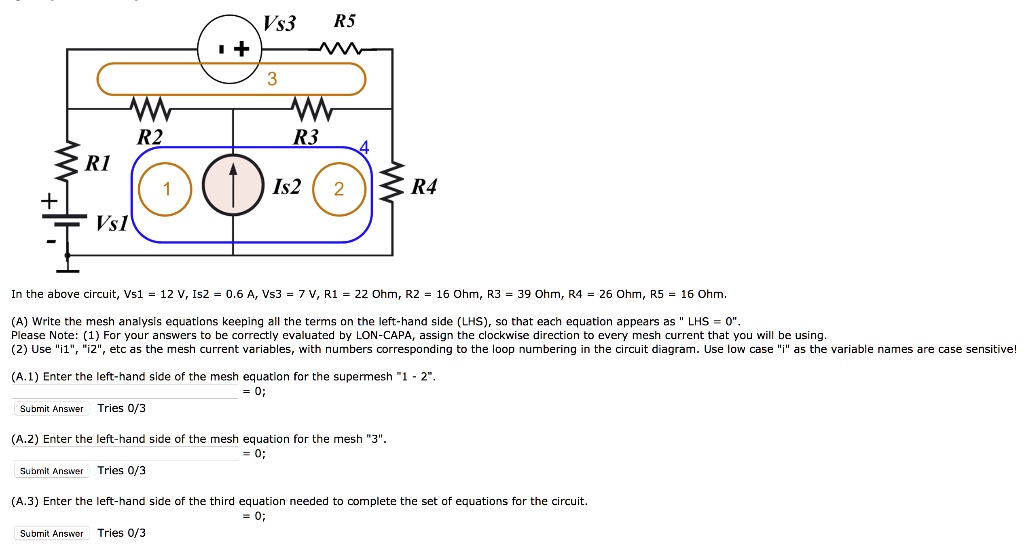
Vs3 R5 + 3 R2 R3 4 R1 1 Is2 2 R4 + Vs1 In the above circuit, Vs1 = 12 V, Is2 = 0.6 A, Vs3 = 7 V, R1 = 22 Ohm, R2 = 16 Ohm, R3 = 39 Ohm, R4 = 26 Ohm, R5 = 16 Ohm. (A) Write the mesh analysis equations keeping all the terms on the left-hand side (LHS), so that each equation appears as " LHS = 0". Please Note: (1) For your answers to be correctly evaluated by LON-CAPA, assign the clockwise direction to every mesh current that you will be using. (2) Use "i1", "i2", etc as the mesh current variables, with numbers corresponding to the loop numbering in the circuit diagram. Use low case "i" as the variable names are case sensitive! (A.1) Enter the left-hand side of the mesh equation for the supermesh "1 - 2". Submit Answer Tries 0/3 = 0; (A.2) Enter the left-hand side of the mesh equation for the mesh "3". Submit Answer Tries 0/3 = 0; (A.3) Enter the left-hand side of the third equation needed to complete the set of equations for the circuit. Submit Answer Tries 0/3 = 0;
View Answer
divider
BEST MATCH

Homework #3 Due Date: 15/04/2020 1 Draw the block diagram of switching modulator and explain its mathematical formulation. Draw any one switching modulator circuit fulfilling this operation.

View Answer
divider
BEST MATCH

12.5 Case Studies with ANSYS Workbench Problem Description: A dog-bone shaped specimen is examined for static, fatigue and buckling failures. The specimen is made of structural steel with geometric dimensions shown below. The bottom face of the specimen is fixed, and the top face of the specimen is applied a static pressure load of 50 MPa. A) Determine whether or not the specimen undergoes plastic deformation under the given static pressure load. B) If the static pres- sure load is changed into a fully reversed cyclic load with a magnitude of 50 MPa, find the life of the specimen, and also determine whether or not fatigue failure occurs in the specimen assuming a design life of $10^6$ cycles. C) Determine whether or not the specimen buckles under the given static pressure load, and obtain the first three buckling mode shapes.

View Answer
divider
BEST MATCH

Find the coefficients of the exponential Fourier series for the function $x(t) = \sum_{k=-\infty}^{\infty} \delta(t - 2k) + 2 \sum_{k=-\infty}^{\infty} \delta(t - (2k + 1))$.

View Answer
divider