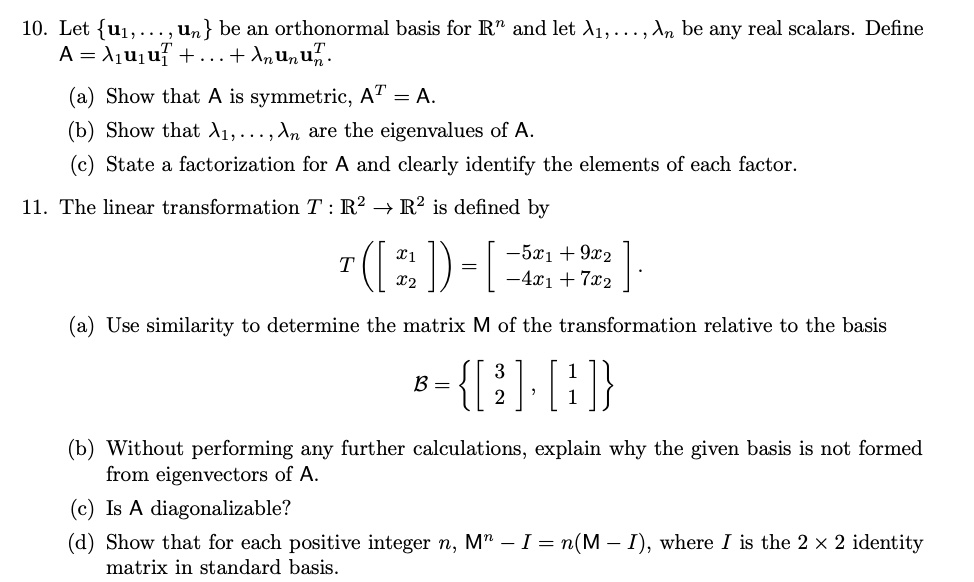
10. Let \{u_1, \dots, u_n\} be an orthonormal basis for \(\mathbb{R}^n\) and let \(\lambda_1, \dots, \lambda_n\) be any real scalars. Define
\(A = \lambda_1 u_1 u_1^T + \dots + \lambda_n u_n u_n^T\).
(a) Show that A is symmetric, \(A^T = A\).
(b) Show that \(\lambda_1, \dots, \lambda_n\) are the eigenvalues of A.
(c) State a factorization for A and clearly identify the elements of each factor.
11. The linear transformation \(T: \mathbb{R}^2 \to \mathbb{R}^2\) is defined by
\(T\begin{bmatrix} x_1\\x_2 \end{bmatrix} = \begin{bmatrix} -5x_1 + 9x_2\\-4x_1 + 7x_2 \end{bmatrix}\).
(a) Use similarity to determine the matrix M of the transformation relative to the basis
\(\mathcal{B} = \left\{ \begin{bmatrix} 3\\2 \end{bmatrix}, \begin{bmatrix} 1\\1 \end{bmatrix} \right\}\)
(b) Without performing any further calculations, explain why the given basis is not formed
from eigenvectors of A.
(c) Is A diagonalizable?
(d) Show that for each positive integer n, \(M^n - I = n(M - I)\), where I is the 2 \times 2 identity
matrix in standard basis.