Question 3
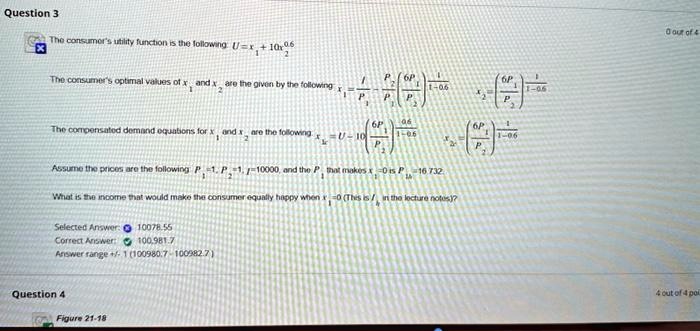
The consumer's utility function is the following: $U = x_1 + 10x_2^{0.6}$
The consumer's optimal values of $x_1$ and $x_2$ are given by the following: $x_1 = \frac{I}{P_1} = \frac{P_2}{P_1} \left(\frac{6P_1}{P_2}\right)^{\frac{1}{1-0.6}}$, $x_2 = \left(\frac{6P_1}{P_2}\right)^{\frac{1}{1-0.6}}$
The compensated demand equations for $x_1$ and $x_2$ are the following: $x_1 = \frac{U-10}{P_1} \left(\frac{6P_1}{P_2}\right)^{\frac{0.6}{1-0.6}}$, $x_2 = \left(\frac{6P_1}{P_2}\right)^{\frac{1}{1-0.6}}$
Assume the prices are the following: $P_1 = 1$, $P_2 = 1$, $I = 10000$, and the $P_1$ that makes $x_1 = 0$ is $P_1 = 16732$.
What is the income that would make the consumer equally happy when $x_1 = 0$ (This is $I_s$ in the lecture notes)?
Selected Answer: 10078.55
Correct Answer: 100981.7
Answer range +/- 1 (100980.7 - 100982.7)
Question 4
Figure 21-18
0 out of 4
4 out of 4 points