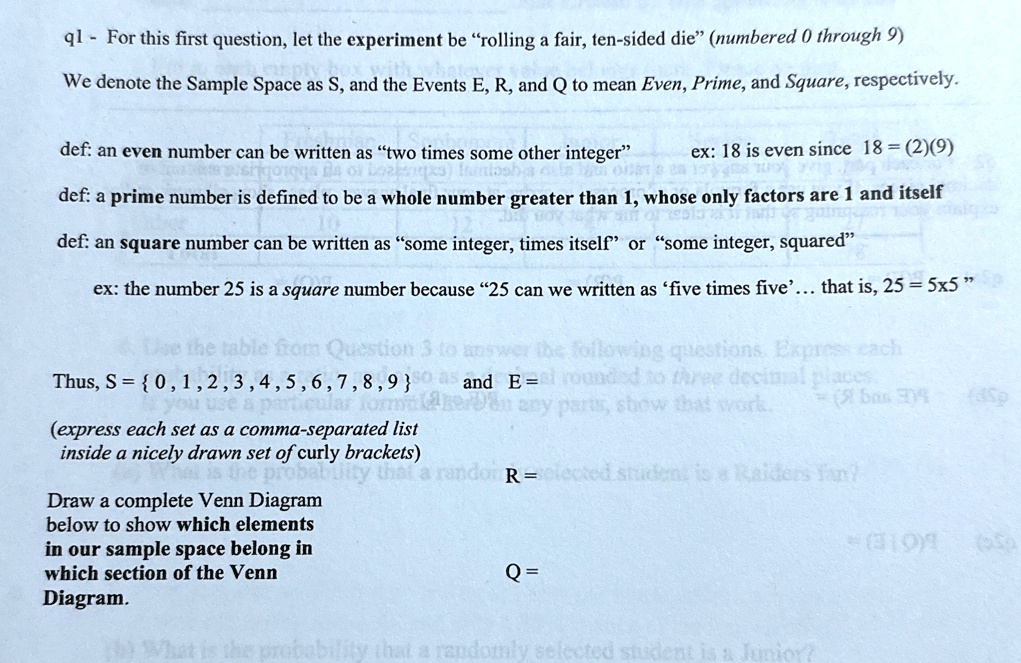
q1 - For this first question, let the experiment be "rolling a fair, ten-sided die" (numbered 0 through 9)
We denote the Sample Space as S, and the Events E, R, and Q to mean Even, Prime, and Square, respectively.
def: an even number can be written as "two times some other integer"
ex: 18 is even since $18 = (2)(9)$
def: a prime number is defined to be a whole number greater than 1, whose only factors are 1 and itself
def: an square number can be written as "some integer, times itself" or "some integer, squared"
ex: the number 25 is a square number because "25 can we written as 'five times five'... that is, $25 = 5 \times 5$"
Thus, $S = \{0, 1, 2, 3, 4, 5, 6, 7, 8, 9\}$ and $E =$
(express each set as a comma-separated list
inside a nicely drawn set of curly brackets)
Draw a complete Venn Diagram
below to show which elements
in our sample space belong in
which section of the Venn
Diagram.
$R = $
$Q = $