Question 1
1 pts
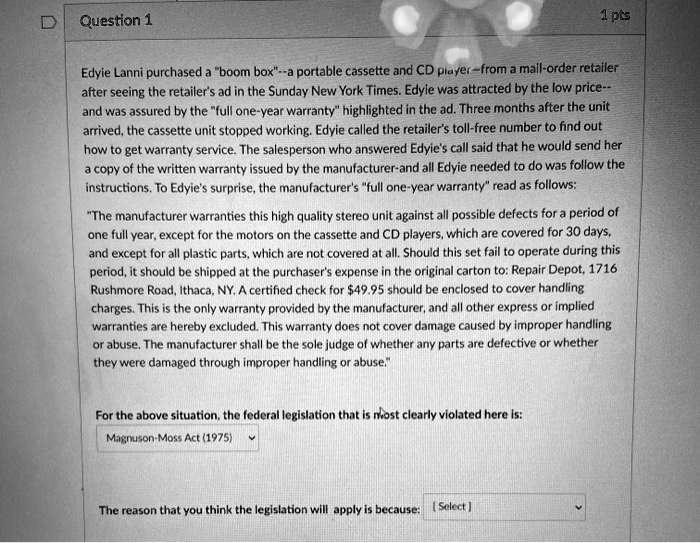
Edyie Lanni purchased a "boom box"--a portable cassette and CD player--from a mail-order retailer
after seeing the retailer's ad in the Sunday New York Times. Edyie was attracted by the low price--
and was assured by the "full one-year warranty" highlighted in the ad. Three months after the unit
arrived, the cassette unit stopped working. Edyie called the retailer's toll-free number to find out
how to get warranty service. The salesperson who answered Edyie's call said that he would send her
a copy of the written warranty issued by the manufacturer--and all Edyie needed to do was follow the
instructions. To Edyie's surprise, the manufacturer's "full one-year warranty" read as follows:
"The manufacturer warranties this high quality stereo unit against all possible defects for a period of
one full year, except for the motors on the cassette and CD players, which are covered for 30 days,
and except for all plastic parts, which are not covered at all. Should this set fail to operate during this
period, it should be shipped at the purchaser's expense in the original carton to: Repair Depot, 1716
Rushmore Road, Ithaca, NY. A certified check for $49.95 should be enclosed to cover handling
charges. This is the only warranty provided by the manufacturer, and all other express or implied
warranties are hereby excluded. This warranty does not cover damage caused by improper handling
or abuse. The manufacturer shall be the sole judge of whether any parts are defective or whether
they were damaged through improper handling or abuse."
For the above situation, the federal legislation that is most clearly violated here is:
Magnuson-Moss Act (1975)
The reason that you think the legislation will apply is because: [Select]