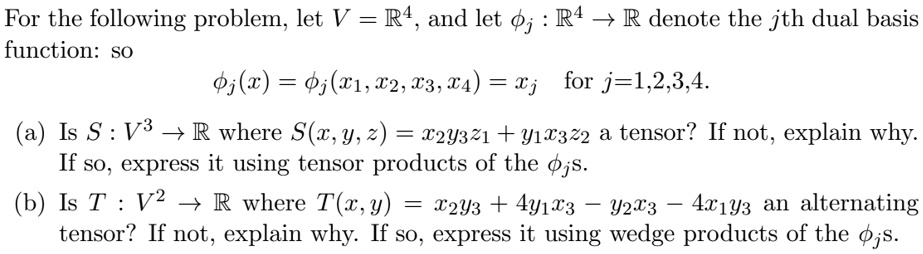
For the following problem, let $V = \mathbb{R}^4$, and let $\phi_j: \mathbb{R}^4 \to \mathbb{R}$ denote the $j$th dual basis function: so \begin{align*} \phi_j(x) = \phi_j(x_1, x_2, x_3, x_4) = x_j \quad \text{for } j = 1, 2, 3, 4. \end{align*} (a) Is $S: V^3 \to \mathbb{R}$ where $S(x, y, z) = x_2y_3z_1 + y_1x_3z_2$ a tensor? If not, explain why. If so, express it using tensor products of the $\phi_js$. (b) Is $T: V^2 \to \mathbb{R}$ where $T(x, y) = x_2y_3 + 4y_1x_3 - y_2x_3 - 4x_1y_3$ an alternating tensor? If not, explain why. If so, express it using wedge products of the $\phi_js.