EXERCISES:
For this Homework assignment, you are required to apply complex number and Fourier series
mathematical techniques. This is a maths assignment, so make sure to include all your workings and
present your results clearly with appropriate units. Also, for each exercise, comment on the
mathematical methods used to solve the problem.
Exercise1: Compute the current flowing in the circuit
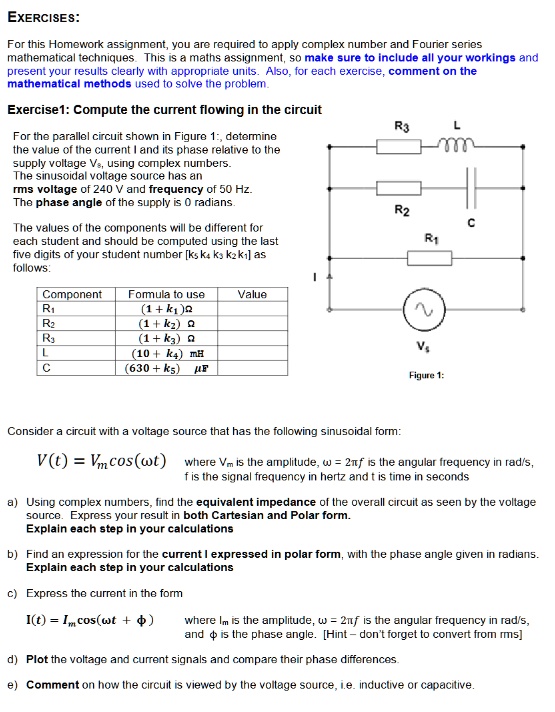
For the parallel circuit shown in Figure 1:, determine
the value of the current I and its phase relative to the
supply voltage Vs, using complex numbers.
The sinusoidal voltage source has an
rms voltage of 240 V and frequency of 50 Hz.
The phase angle of the supply is 0 radians.
The values of the components will be different for
each student and should be computed using the last
five digits of your student number [ks k4 k3 k2k1] as
follows:
Component Formula to use Value
R1 (1+k1) Ω
R2 (1+k2) Ω
R3 (1+k3) Ω
L (10+k4) mH
C (630 + k5) μF
Consider a circuit with a voltage source that has the following sinusoidal form:
$V(t) = V_m cos(\omega t)$
where $V_m$ is the amplitude, $\omega = 2\pi f$ is the angular frequency in rad/s,
f is the signal frequency in hertz and t is time in seconds
a) Using complex numbers, find the equivalent impedance of the overall circuit as seen by the voltage
source. Express your result in both Cartesian and Polar form.
Explain each step in your calculations
b) Find an expression for the current I expressed in polar form, with the phase angle given in radians.
Explain each step in your calculations
c) Express the current in the form
$I(t) = I_m cos(\omega t + \phi)$
where $I_m$ is the amplitude, $\omega = 2\pi f$ is the angular frequency in rad/s,
and $\phi$ is the phase angle. [Hint don't forget to convert from rms]
d) Plot the voltage and current signals and compare their phase differences.
e) Comment on how the circuit is viewed by the voltage source, i.e. inductive or capacitive.