2. Bead on rotating wire
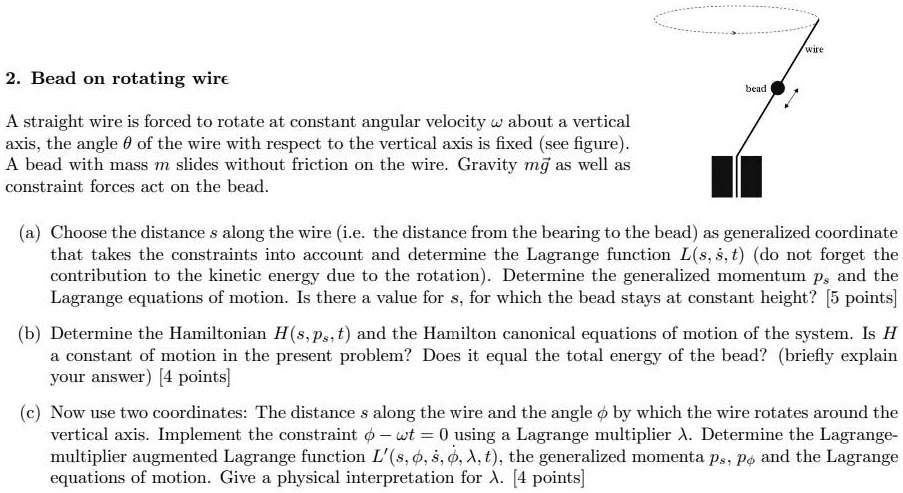
A straight wire is forced to rotate at constant angular velocity \omega about a vertical
axis, the angle \theta of the wire with respect to the vertical axis is fixed (see figure).
A bead with mass m slides without friction on the wire. Gravity m\vec{g} as well as
constraint forces act on the bead.
(a) Choose the distance s along the wire (i.e. the distance from the bearing to the bead) as generalized coordinate
that takes the constraints into account and determine the Lagrange function L(s,\dot{s},t) (do not forget the
contribution to the kinetic energy due to the rotation). Determine the generalized momentum p_s and the
Lagrange equations of motion. Is there a value for s, for which the bead stays at constant height? [5 points]
(b) Determine the Hamiltonian H(s,p_s,t) and the Hamilton canonical equations of motion of the system. Is H
a constant of motion in the present problem? Does it equal the total energy of the bead? (briefly explain
your answer) [4 points]
(c) Now use two coordinates: The distance s along the wire and the angle \phi by which the wire rotates around the
vertical axis. Implement the constraint \phi - \omega t = 0 using a Lagrange multiplier \lambda. Determine the Lagrange-
multiplier augmented Lagrange function L'(s, \dot{s}, \phi, \dot{\phi}, \lambda, t), the generalized momenta p_s, p_\phi and the Lagrange
equations of motion. Give a physical interpretation for \lambda. [4 points]