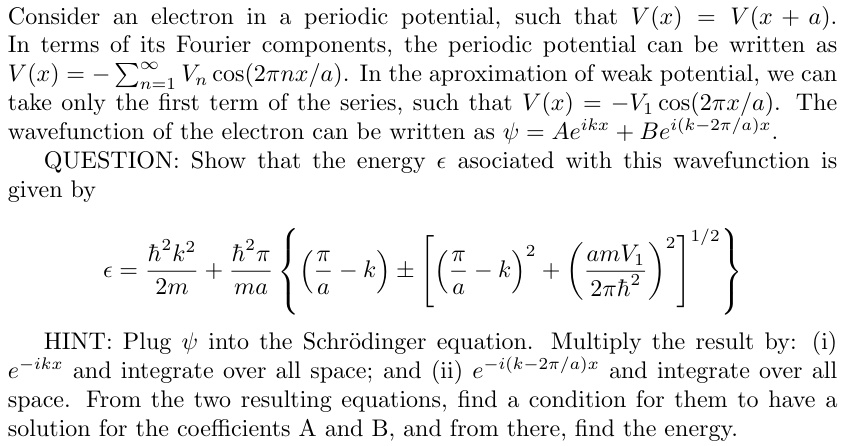
Consider an electron in a periodic potential, such that $V(x) = V(x + a)$. In terms of its Fourier components, the periodic potential can be written as $V(x) = -\sum_{n=1}^{\infty} V_n \cos(2\pi nx/a)$. In the approximation of weak potential, we can take only the first term of the series, such that $V(x) = -V_1 \cos(2\pi x/a)$. The wavefunction of the electron can be written as $\psi = Ae^{ikx} + Be^{i(k-2\pi/a)x}$.
QUESTION: Show that the energy $\epsilon$ associated with this wavefunction is given by
$\epsilon = \frac{\hbar^2 k^2}{2m} + \frac{\hbar^2 \pi}{ma} \left\{ \left(\frac{\pi}{a} - k\right) \pm \left[ \left(\frac{\pi}{a} - k\right)^2 + \left(\frac{amV_1}{2\pi \hbar^2}\right)^2 \right]^{1/2} \right\}$
HINT: Plug $\psi$ into the Schrödinger equation. Multiply the result by: (i) $e^{-ikx}$ and integrate over all space; and (ii) $e^{-i(k-2\pi/a)x}$ and integrate over all space. From the two resulting equations, find a condition for them to have a solution for the coefficients A and B, and from there, find the energy.