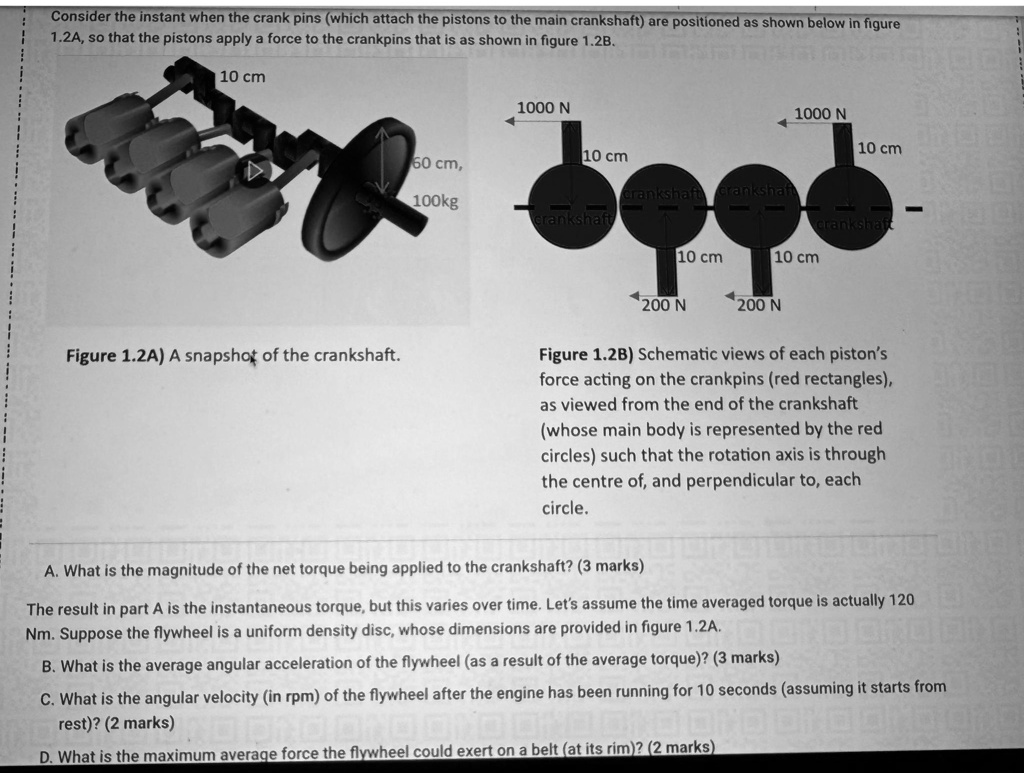
Consider the instant when the crank pins (which attach the pistons to the main crankshaft) are positioned as shown below in figure 1.2A, so that the pistons apply a force to the crankpins that is as shown in figure 1.2B.
Figure 1.2A) A snapshot of the crankshaft.
Figure 1.2B) Schematic views of each piston's force acting on the crankpins (red rectangles), as viewed from the end of the crankshaft (whose main body is represented by the red circles) such that the rotation axis is through the centre of, and perpendicular to, each circle.
A. What is the magnitude of the net torque being applied to the crankshaft? (3 marks)
The result in part A is the instantaneous torque, but this varies over time. Let's assume the time averaged torque is actually 120 Nm. Suppose the flywheel is a uniform density disc, whose dimensions are provided in figure 1.2A.
B. What is the average angular acceleration of the flywheel (as a result of the average torque)? (3 marks)
C. What is the angular velocity (in rpm) of the flywheel after the engine has been running for 10 seconds (assuming it starts from rest)? (2 marks)
D. What is the maximum average force the flywheel could exert on a belt (at its rim)? (2 marks)
Consider the instant when the crank pins (which attach the pistons to the main crankshaft) are positioned as shown below in figure 1.2A, so that the pistons apply a force to the crankpins that is as shown in figure 1.2B
10 cm
1000N
1000N
10cm
10cm
60cm,
100kg
10
10cm
10cm
200N
200N
Figure 1.2A) A snapshot of the crankshaft
Figure 1.2B) Schematic views of each piston's force acting on the crankpins (red rectangles) as viewed from the end of the crankshaft (whose main body is represented by the red circles) such that the rotation axis is through the centre of, and perpendicular to, each circle.
A. What is the magnitude of the net torque being applied to the crankshaft? (3 marks) The result in part A is the instantaneous torque, but this varies over time. Let's assume the time averaged torque is actually 120 Nm. Suppose the flywheel is a uniform density disc, whose dimensions are provided in figure 1.2A B. What is the average angular acceleration of the flywheel (as a result of the average torque)? (3 marks C. What is the angular velocity (in rpm) of the flywheel after the engine has been running for 10 seconds (assuming it starts from rest)? (2 marks) D. What is the maximum average force the flywheel could exert on a belt at its rim)? (2 marks