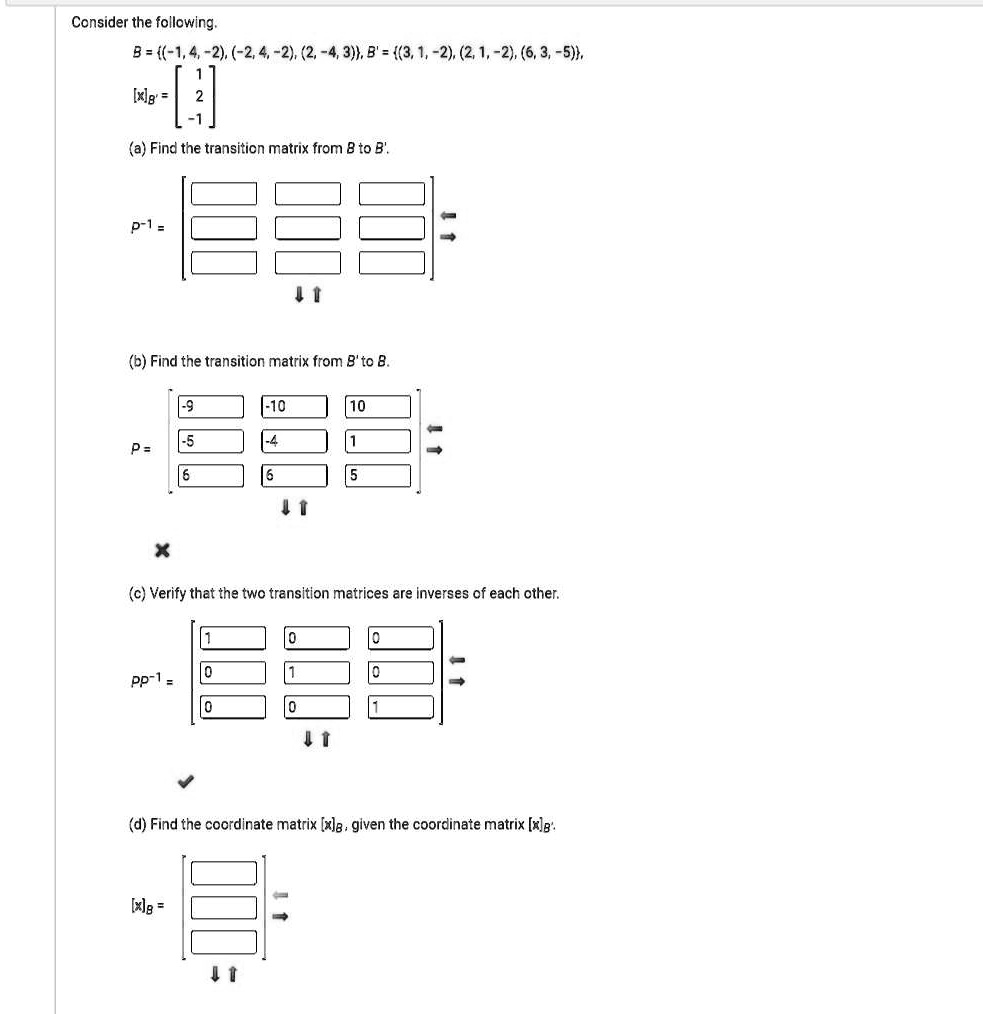
Consider the following.
B = {(-1, 4, -2), (-2, 4, -2), (2, -4, 3)}, B' = {(3, 1, -2), (2, 1, -2), (6, 3, -5)},
$\begin{bmatrix} 1 \ 2 \ 1 \end{bmatrix}$
(a) Find the transition matrix from B to B'.
$P^{-1} = \begin{bmatrix} \\ \\ \end{bmatrix} \implies \begin{bmatrix} \\ \\ \end{bmatrix}$
(b) Find the transition matrix from B' to B.
$\begin{bmatrix} -9 & -10 & 10 \\ -5 & -4 & 1 \\ 6 & 6 & 5 \end{bmatrix} \implies \begin{bmatrix} \\ \\ \end{bmatrix}$
(c) Verify that the two transition matrices are inverses of each other.
$\begin{bmatrix} 1 & 0 & 0 \\ 0 & 1 & 0 \\ 0 & 0 & 1 \end{bmatrix} \implies \begin{bmatrix} \\ \\ \end{bmatrix}$
(d) Find the coordinate matrix $[x]_B$, given the coordinate matrix $[x]_{B'}$.
$[x]_B = \begin{bmatrix} \\ \\ \end{bmatrix} \implies \begin{bmatrix} \\ \\ \end{bmatrix}$