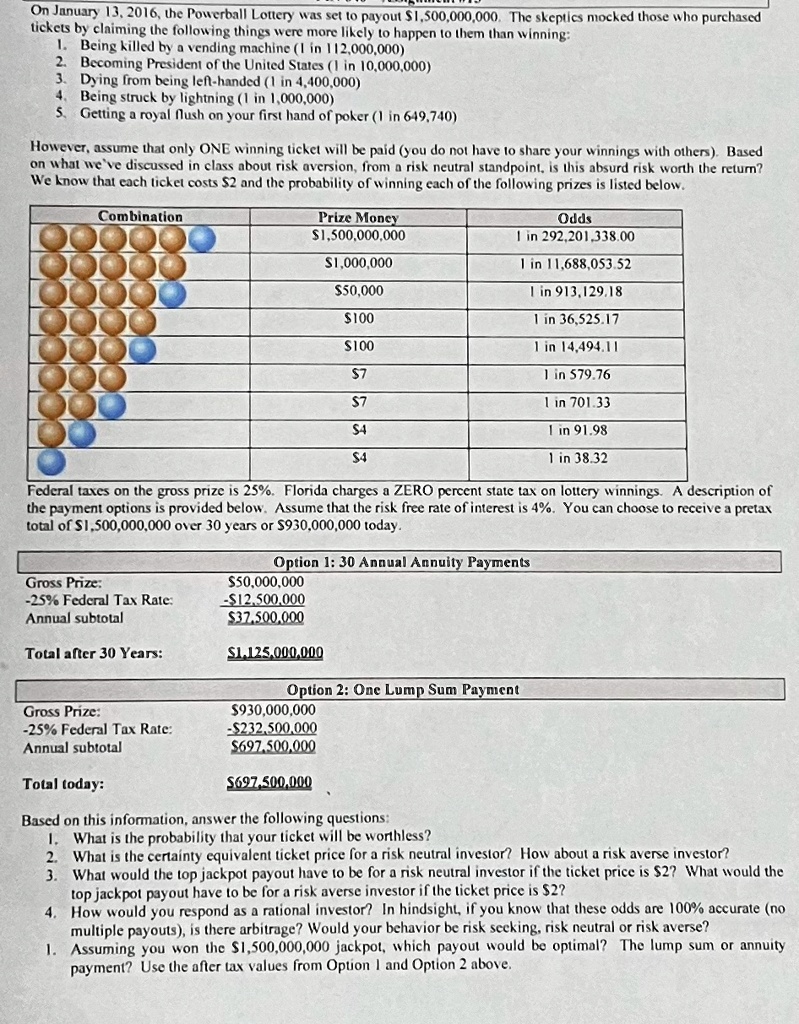
On January 13, 2016, the Powerball Lottery was set to payout $1,500,000,000. The skeptics mocked those who purchased tickets by claiming the following things were more likely to happen to them than winning:
1. Being killed by a vending machine (1 in 112,000,000)
2. Becoming President of the United States (1 in 10,000,000)
3. Dying from being left-handed (1 in 4,400,000)
4. Being struck by lightning (1 in 1,000,000)
5. Getting a royal flush on your first hand of poker (1 in 649,740)
However, assume that only ONE winning ticket will be paid (you do not have to share your winnings with others). Based on what we've discussed in class about risk aversion, from a risk neutral standpoint, is this absurd risk worth the return?
We know that each ticket costs $2 and the probability of winning each of the following prizes is listed below.
Combination
Prize Money
Odds
$1,500,000,000
1 in 292,201,338.00
$1,000,000
1 in 11,688,053.52
$50,000
1 in 913,129.18
$100
1 in 36,525.17
$100
1 in 14,494.11
$7
1 in 579.76
$7
1 in 701.33
$4
1 in 91.98
$4
1 in 38.32
Federal taxes on the gross prize is 25%. Florida charges a ZERO percent state tax on lottery winnings. A description of the payment options is provided below. Assume that the risk free rate of interest is 4%. You can choose to receive a pretax total of $1,500,000,000 over 30 years or $930,000,000 today.
Option 1: 30 Annual Annuity Payments
Gross Prize:
$50,000,000
-25% Federal Tax Rate:
-$12,500,000
Annual subtotal
$37,500,000
Total after 30 Years:
$1,125,000,000
Option 2: One Lump Sum Payment
Gross Prize:
$930,000,000
-25% Federal Tax Rate:
-$232,500,000
Annual subtotal
$697,500,000
Total today:
$697,500,000
Based on this information, answer the following questions:
1. What is the probability that your ticket will be worthless?
2. What is the certainty equivalent ticket price for a risk neutral investor? How about a risk averse investor?
3. What would the top jackpot payout have to be for a risk neutral investor if the ticket price is $2? What would the top jackpot payout have to be for a risk averse investor if the ticket price is $2?
4. How would you respond as a rational investor? In hindsight, if you know that these odds are 100% accurate (no multiple payouts), is there arbitrage? Would your behavior be risk seeking, risk neutral or risk averse?
1. Assuming you won the $1,500,000,000 jackpot, which payout would be optimal? The lump sum or annuity payment? Use the after tax values from Option 1 and Option 2 above.